
Solution
EV Charger Energy Meter & Check Meter
Bill Every Charger. Verify Every Tariff.
An EV meter dedicated to EV charging metering — revenue-grade measurement on the AC circuit feeding each charger, independent of the meter inside the charger itself. It enables per-charger billing, demand management, tariff verification, and cost allocation across commercial fleets and residential complexes.
Hero MotoCorp uses Titan meters as check meters on its EV chargers.
The Billing Problem
EV chargers have their own meters, and ours are Class 1 — right for billing each charging session. But the session record belongs to whoever runs the charger. When a landlord, housing society or tenant needs its own record of the energy — to allocate cost, verify a tariff, or settle a disputed bill — it helps to have a second, independent meter.
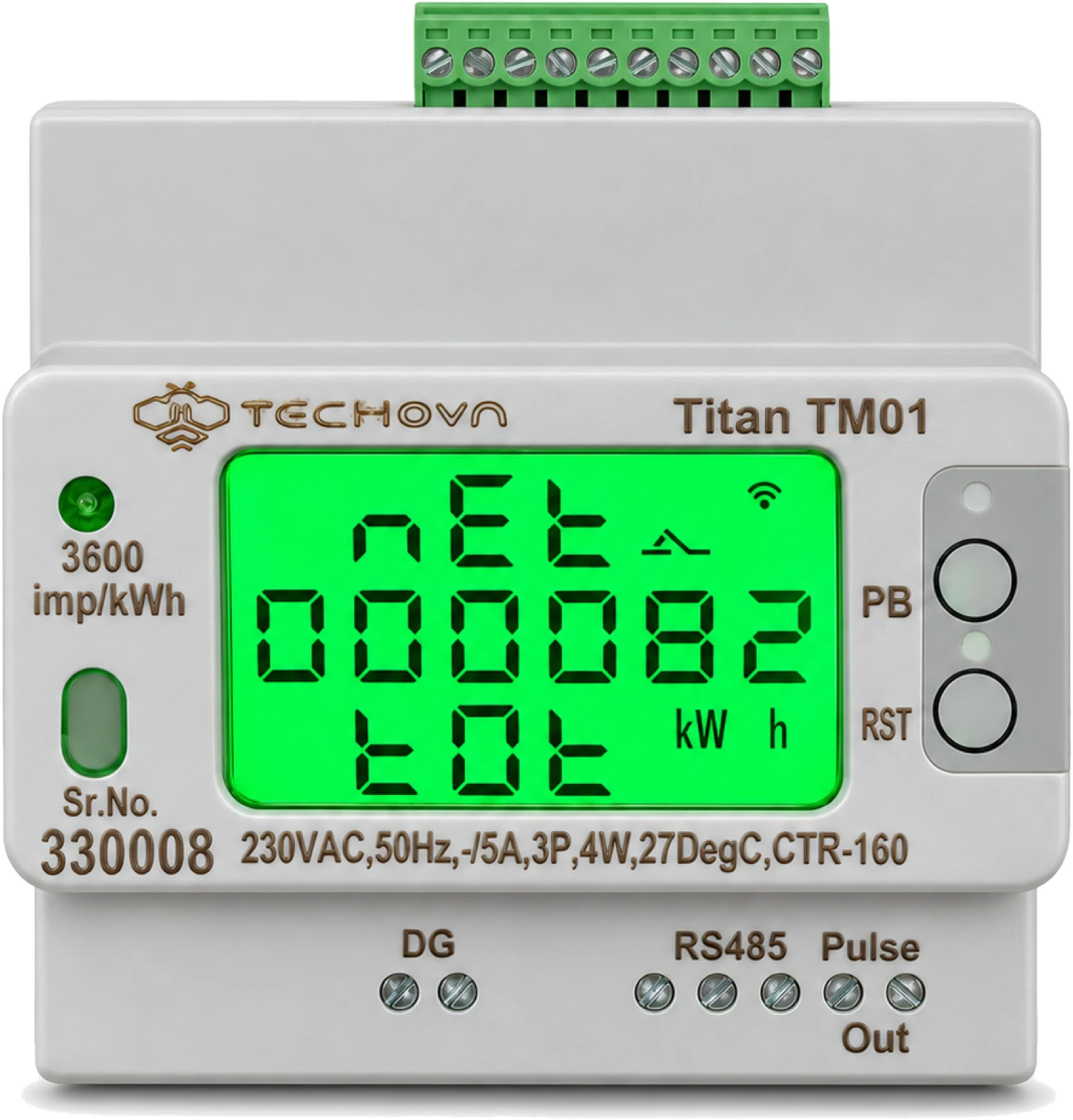
A dedicated Titan meter on the circuit feeding the charger provides that second source — Class 0.5S accuracy, independent kWh totals, time-of-use registers, and a cloud dashboard the customer can audit themselves.
Is Your EV Charger Measuring Correctly?
To check, put an independent check meter on the AC circuit feeding the charger and compare the two kWh totals over the same period. A small, steady gap is normal. A gap that keeps widening means the charger's reading is drifting.
- Fit a check meter on the charger circuit. A Class 0.5S Titan goes on the existing DIN rail in the panel, with no change to the charger.
- Log both for 2–4 weeks. Take the check meter's total kWh, and the sum of session kWh the charger or its CSMS reports for the same dates.
- Expect a small gap. The check meter also sees the charger's own standby consumption, and on DC chargers the AC-to-DC conversion loss, so it reads a little higher than the sessions add up to.
- Watch the trend, not one reading. If the gap stays steady month to month, the charger is measuring consistently. If it keeps growing, the charger's reading is drifting. Have it recalibrated or replaced before more sessions are billed on it.
- Spot-check single sessions. When only one vehicle is charging, compare that session's kWh with the check meter's interval data for the same window.
How to Prevent Electricity Theft at EV Chargers
At housing societies and parking lots, most unbilled charging energy is not dramatic theft. It is energy drawn on a charger circuit that never shows up as a billed session. A separate meter on every charger circuit, reconciled each month against what was billed, is what catches it.
Any charger whose metered kWh runs well ahead of its billed kWh, beyond its usual standby loss, is the one to investigate. Here is where the energy usually goes:
Energy drawn with no session
A socket tapped off the charger circuit, or a charger left in free-vend or bypass mode. Titan logs the circuit at 15-minute intervals, so consumption at times when the charger log shows no session stands out in the data.
Sessions recorded low or not at all
A charger meter reading low, or sessions lost when the charger drops offline. A monthly reconciliation of metered kWh against billed kWh shows the gap, charger by charger.
Shared feeders with no per-charger meter
When several chargers share one feeder, their energy lands on the common-area bill and nobody can say which charger used it. One meter per charger circuit puts every kWh against a charger.
Check Meter vs Charger Meter vs DISCOM Meter
Three meters can see the same charging energy. They belong to different people and answer different questions.
| DISCOM meter | Charger's built-in meter | Check meter (Titan) | |
|---|---|---|---|
| Who owns it | The utility (DISCOM) | The charger operator | You — the site owner, society or landlord |
| What it measures | The whole site's supply | Each charging session | Everything on the circuit feeding each charger |
| What it is used for | Your electricity bill | Billing EV users per session | Verifying the charger's readings and catching unbilled energy |
| Accuracy | Set by the utility | Varies by brand (Class 1 on Tech OVN chargers) | Class 0.5S on Titan |
More on the difference: sub-meter vs check meter vs revenue meter.
Why Add a Second Meter
Five reasons facility managers and EV operators install dedicated metering upstream of every charger.
An Independent Second Meter
The meter inside a charger (Class 1 on Tech OVN chargers) measures each session for the operator. A Class 0.5S Titan on the circuit feeding the charger gives the landlord or billing party an independent reading of the same energy — useful when two parties need to agree on a bill.
Data the Site Owner Holds
Session data from a charger flows to whichever CSMS the operator runs. Titan's data belongs to the site owner, independent of the charger brand or the charging software — so the record stays with the building even if the operator or software changes.
Per-Tenant Cost Allocation
Apartment buildings, commercial offices, and fleet depots need to allocate charging costs back to specific tenants, employees, or vehicles. Titan's TOU registers and per-circuit metering make tenant billing defensible.
Demand Management
Chargers can add to a building's peak demand and trigger contract penalties. Titan tracks 15-minute demand intervals and feeds the data into the platform for automated alerts before you cross the threshold.
Green Tariff Verification
If you're on a green energy tariff or claiming Scope 2 emissions reductions, the utility and your auditor want defensible kWh data. Titan calculates CO₂ on-device using configurable grid emission factors per source.
How It Works
Install one Titan meter per charger circuit on the existing DIN rail in the panel. Connect to the building WiFi or Ethernet. The meter starts logging immediately — kWh, V, I, P, PF, harmonics, demand — and streams data to the cloud dashboard.
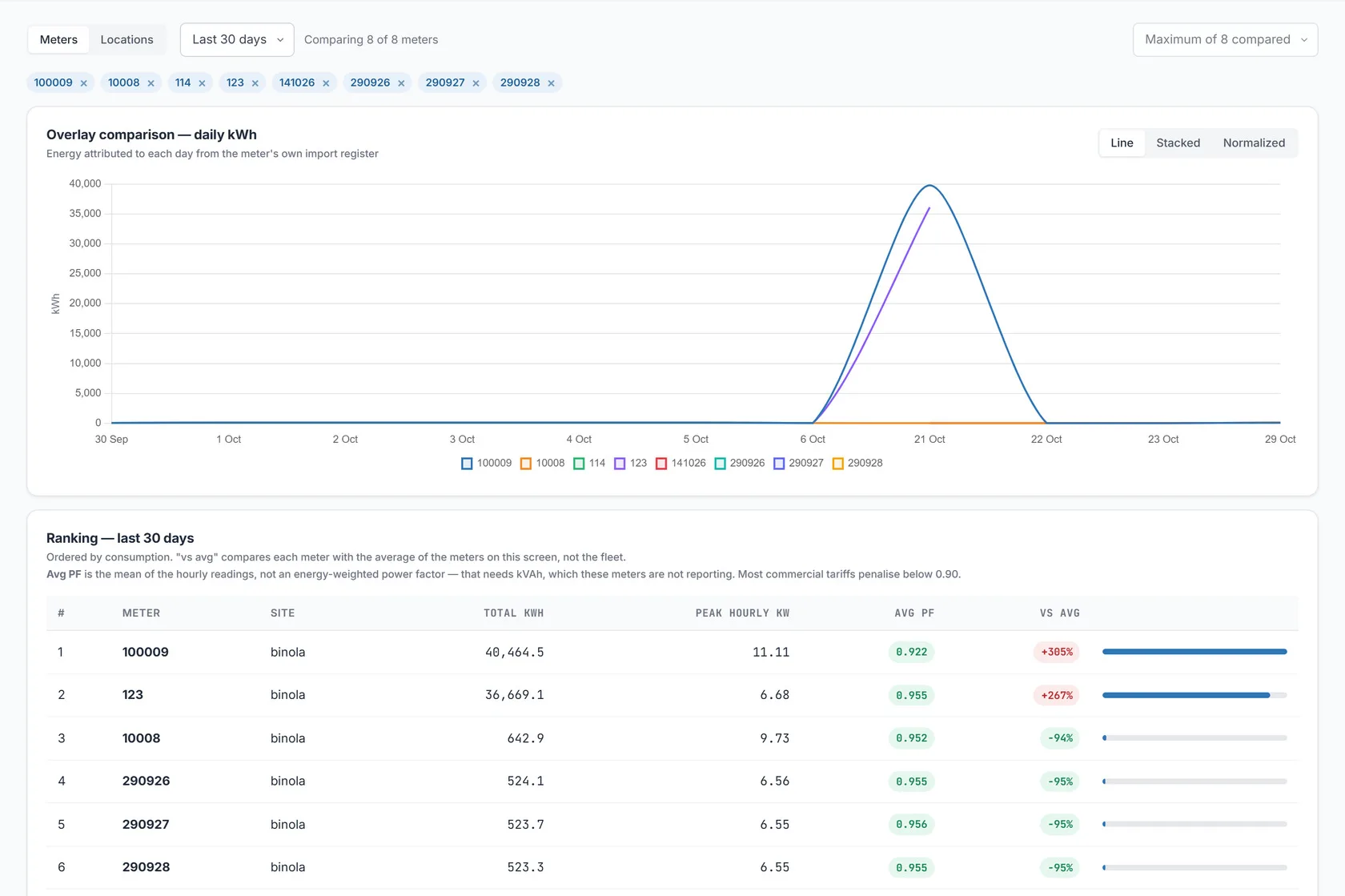
For multi-charger sites, every Titan rolls up into a portfolio view on the Energy Intelligence Platform: per-charger consumption, per-tenant allocation, peak demand alerts, and CO₂ totals — across one site or thousands.
Use Cases
From a single home charger to multi-site fleet depots — five common scenarios.
Commercial Office Buildings
Allocate charging costs to specific employees or departments. Avoid bundling EV charging into general electricity bills.
Residential Complexes
Per-resident billing for shared chargers, with monthly invoices and consumption transparency.
Fleet Depots
Track per-vehicle energy cost. Monitor charger utilisation. Catch demand spikes before they trigger penalty tariffs.
Public Charging Networks
Independent revenue verification across CPO platforms. Defensible audit trail for partners and regulators.
Retail & Hospitality
Track charging as a customer amenity vs cost centre. Tie consumption to footfall or loyalty data.
Why Titan for EV Charging
Hero MotoCorp uses Titan meters as check meters on its EV chargers. Here is why Titan suits the EV charging circuit:
- Class 0.5S accuracy per IEC 62053-22 — utility-grade
- Works with any charger brand — it sits on the AC feed, no integration
- WiFi or Ethernet to the cloud — no gateway hardware
- TOU registers for time-based tariffs and demand charges
- CO₂ on-device calculation for green tariff and ESG reporting
- Ships 4 weeks from PO
The full Titan spec sheet is on the Titan product page.
Frequently Asked Questions
Common questions about checking EV charger accuracy, unbilled energy, and per-charger metering.
Related Solutions & Products
The full EV stack — chargers, controllers, and the meter that keeps them honest.
EV Chargers
AC EV chargers 3.3–22 kW, Type 2 and single-socket, with OCPP 1.6J & 2.0.1. White-label and OEM available.
Learn More →EV Charger Controller
OEM controller board for charger manufacturers — integrated relay, protection, metering, and connectivity.
Learn More →Titan Smart Energy Meter
Class 0.5S DIN rail EV charger energy meter on the upstream AC circuit — the revenue-grade meter for per-charger billing.
Learn More →EV Charger Sizing Calculator
Work out which charger and how many you need — the first step before planning the metering layer.
Learn More →EV Charging Cost Per KM
Calculate EV running cost at your tariff and compare against petrol — useful for fleet-ROI conversations.
Learn More →Ready to bill every charger properly?
Talk to our EV infrastructure team about per-charger metering for your fleet, building, or charging network.