
Solution
Reduce Electricity Costs in Your Factory
Measure. Identify. Verify.
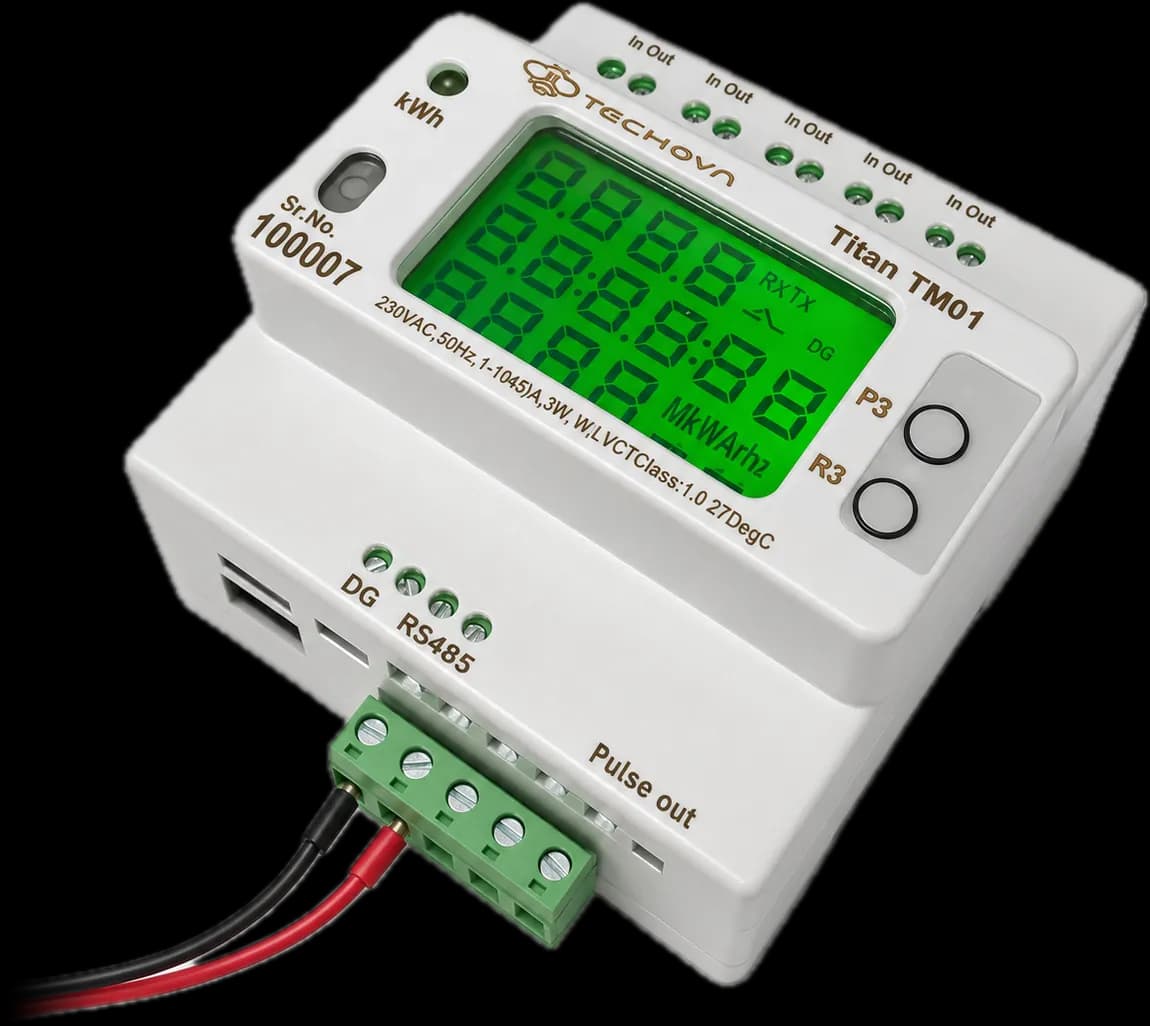
Industrial energy efficiency means reducing the electricity a factory uses, or pays for, per unit of output, through demand management, power factor correction, eliminating phantom loads and better scheduling. Tech OVN's approach is measurement-led: Titan Class 0.5S meters on every distribution board and major load identify where energy is wasted, then verify each fix with continuous M&V data.
You can't reduce what you don't measure. Tech OVN's energy efficiency system puts a smart meter on every circuit, identifies the specific sources of energy waste, and continuously verifies that your efficiency measures are working — turning energy from an uncontrollable overhead into a manageable, reducible cost.
Six Levers to Reduce Energy Consumption
Every facility has energy waste hidden in plain sight. These are the six most common savings opportunities that circuit-level metering exposes.
Demand Management
On most Indian HT and LT-industrial tariffs the demand charge is billed on your highest 15-minute demand of the month (subject to a minimum percentage of contract demand), and demand above contract demand attracts a penalty. Titan tracks the 15-minute demand window in real time and alerts before a block sets a new monthly peak or crosses your contract demand. Stagger heavy loads, shift non-critical processes to off-peak hours, and cut demand charges without reducing production.
Power Factor Correction
Poor power factor attracts penalties from DISCOMs and wastes transformer capacity. Titan measures real-time PF per circuit, identifies the worst offenders, and helps you place and size capacitor banks where they'll have the biggest impact, rather than only at the incomer.
Phantom Load Elimination
Equipment running outside production hours — compressors, chillers, lighting, exhaust fans — is energy you pay for with nothing to show for it. Runtime analysis and on/off event logging identify exactly which circuits run when they shouldn't.
Schedule Optimisation
Overlay production schedules with energy consumption profiles. Identify which shifts and processes are least energy-efficient. Quantify the impact of process changes before and after implementation.
Motor & Compressor Efficiency
Degrading motors draw more current for the same work. Harmonics analysis and power factor trending per motor circuit can reveal efficiency degradation well before failure — enabling planned replacement rather than emergency repair.
Post-Retrofit Verification
Installed VFDs, LED lighting, or new compressors? Titan provides continuous M&V data proving the energy savings are real and sustained — not just a one-month improvement that fades.
How to Reduce Energy Consumption — Step by Step
A practical energy saving roadmap from first meter to verified savings.
- 1
Install meters on every distribution board and major load — split-core CTs with Titan Audit for a survey, or permanent CTs with Titan
- 2
Connect to the Energy Intelligence Platform for automated baseline and load profiling
- 3
Identify the biggest energy waste sources from the dashboard
- 4
Implement demand management, schedule changes, and PF correction based on data
- 5
Track savings continuously — the same meters that found the waste verify the fix
Energy Saving Solutions for Industry
Energy saving solutions tailored to each industry's load profile and tariff structure.
Manufacturing & Production
Motor loads, compressors, furnaces, HVAC, compressed air systems. Demand management and schedule optimisation are usually the first levers.
Commercial Buildings
HVAC, lighting, elevators, common areas. Tenant-level sub-metering identifies who uses what and incentivises efficiency.
Data Centres
PUE tracking, cooling efficiency, UPS losses, and IT vs. facility load separation. At data-centre scale, even small improvements are worth measuring.
Warehousing & Cold Chain
Refrigeration compressor efficiency, door-open energy loss quantification, lighting schedules. Temperature-correlated energy analysis.
Frequently Asked Questions
Common questions about reducing electricity costs, energy efficiency systems, and ROI.
Related Solutions & Products
Measure, audit, then reduce — a continuous energy efficiency workflow.
AI condition monitoring
The same meter, read for equipment health: runtime, inrush and current-distortion trends flag a motor drifting from its commissioned behaviour weeks before it fails.
Learn More →Facility management
Where efficiency and condition monitoring meet — one measurement layer serving both the energy budget and the maintenance budget.
Learn More →Energy Management System (EMS)
The cloud EMS where energy-efficiency measures are verified — ISO 50001 EnPI baseline, post-retrofit M&V, and reporting that supports BEE PAT workflows.
Learn More →Energy Audit & Logger
Baseline factory consumption with split-core CTs. Equipment for energy auditors and ESCOs, with reports that support BEE PAT workflows.
Learn More →Energy Monitoring System
Circuit-level real-time monitoring — the ongoing M&V that verifies every efficiency measure.
Learn More →Titan Smart Energy Meter
Class 0.5S DIN rail meter for permanent installation — identifies the waste and verifies the fix.
Learn More →Diesel Genset vs Grid Calculator
Compare the true per-kWh cost of your DG versus grid power.
Learn More →Energy Audit ROI Calculator
Model an audit + retrofit programme for your facility with your own bill figures.
Learn More →Ready to cut your energy costs?
Talk to our team about which circuits to meter first in your factory, building, or campus.