Solution
Solar Power Monitoring System — PV, Grid, and DG on One Dashboard
Measure Every Source. Prove Every Saving.
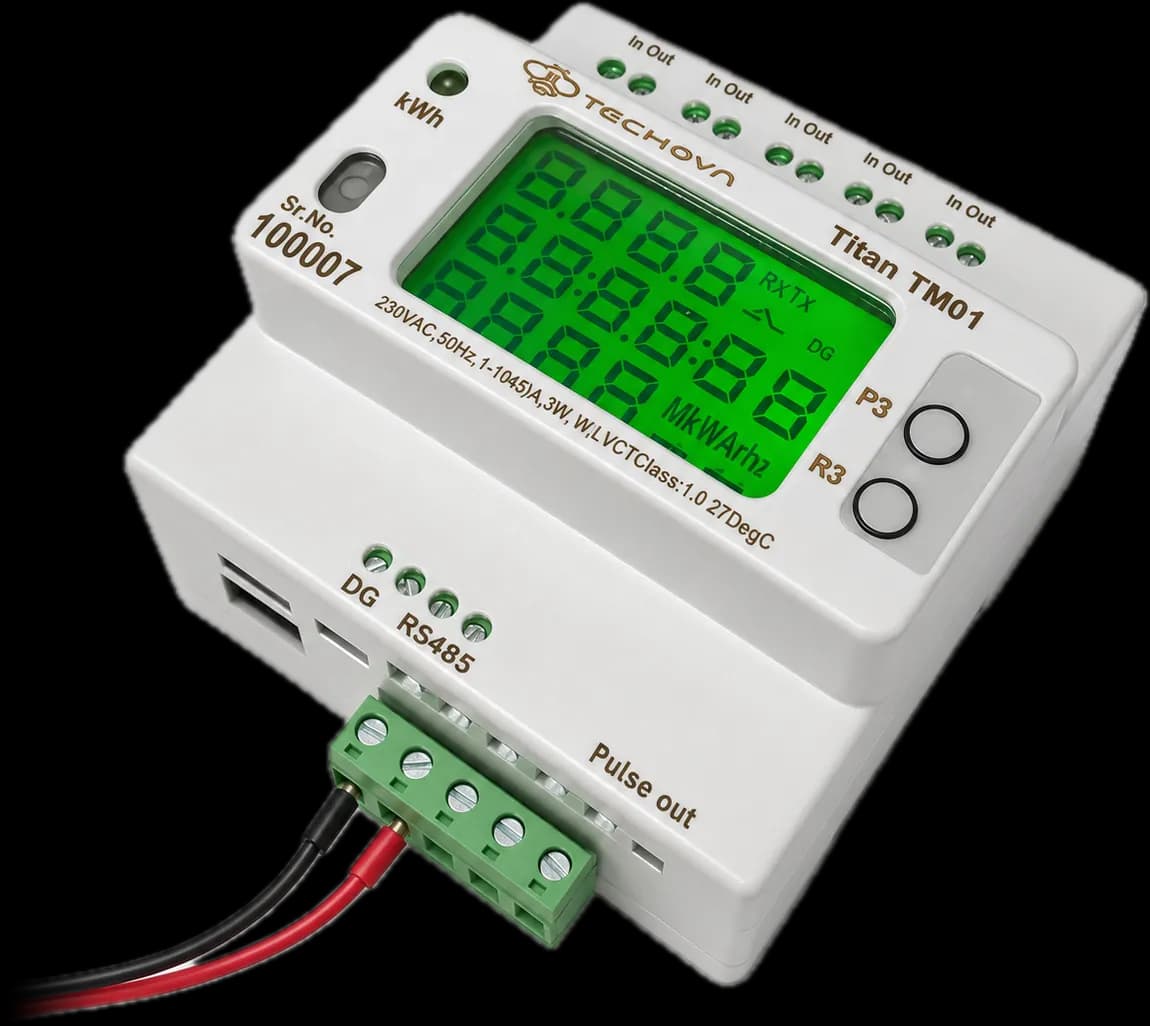
A solar monitoring system measures generation, grid import/export, and (optionally) diesel generator output across the same dashboard — letting facility owners verify solar performance, calculate true self-consumption, justify storage, and comply with net metering. Tech OVN's Titan smart meter delivers bi-directional metering on every source with WiFi or Ethernet to the cloud.
Why Inverter Monitoring Isn't Enough
Solar inverters report what the inverter sees: DC input, AC output, error codes. They don't see grid import, they don't see diesel runtime, and they don't see what the building actually consumes. That makes it impossible to answer the questions that matter most:
- • What percentage of solar generation is being self-consumed (vs exported)?
- • What is the blended cost of energy across solar, grid, and DG combined?
- • How much grid dependency has solar actually displaced?
- • Is a BESS justified — and what size?
A dedicated meter on every source — solar, grid, and DG — closes the gap. Titan provides bi-directional Class 0.5S measurement on all of them, with the same cloud dashboard rolling up the data into actionable comparisons.
Solar Power Monitoring System — What Titan Measures
Four data streams, one dashboard. A solar power monitoring system that also covers grid import/export and diesel generator output.
Solar Generation
kWh delivered to the building, peak generation, self-consumption ratio, daily and seasonal trends.
Grid Import & Export
Bi-directional metering for net metering compliance. Time-of-use registers for peak/off-peak tariffs.
Diesel Generator
Runtime hours, fuel cost (configurable), kWh delivered, and CO₂ emissions.
Building Load
Total consumption per phase, per circuit, per tenant — across the entire facility.
Renewable Comparison Engine
The platform's renewable comparison engine takes the per-source data from Titan and produces:
- Source-wise kWh and cost — solar, grid, DG broken out month over month
- Blended cost of energy — what you actually paid per kWh once all sources are factored in
- Solar self-consumption % — how much PV generation stayed on-site
- Grid dependency % — how much you still pull from the utility
- DG runtime + fuel cost — diesel as a true line item
- Source-mix charts — at-a-glance daily, monthly, and annual breakdowns
For BESS feasibility, the platform also runs load profile analysis, solar surplus windows, recommended capacity, and payback ROI with tariff sensitivity scenarios.
Read more about the renewable comparison engine →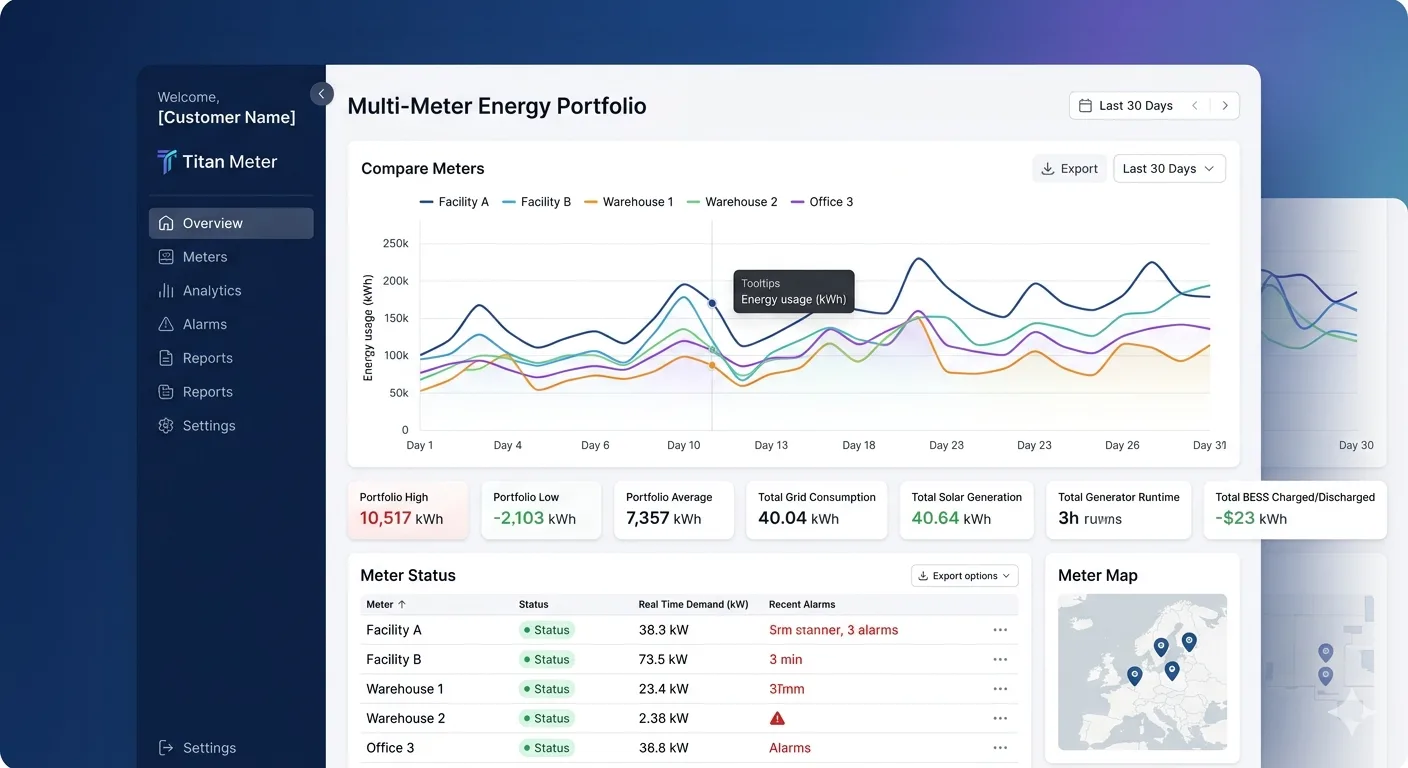
Use Cases
Five common scenarios from rooftop solar to multi-site portfolios.
Commercial Rooftop Solar
Verify EPC performance against PPA guarantees. Track solar self-consumption vs grid export over time. Monitor inverter health from the AC side.
Solar EPC Portfolios
Aggregate dashboards across multiple client sites. Defensible reporting on plant performance, with no dependence on a single inverter portal.
Industrial Facilities with DG Backup
Compare grid + solar + DG costs side by side. Identify when DG is being run uneconomically. Plan BESS to displace diesel.
Net Metering Compliance
Bi-directional metering with import and export registers, time-of-use tracking, and audit-ready exports for the utility.
Solar + BESS Sites
Track BESS charge/discharge cycles, calculate round-trip efficiency, and validate storage ROI against the original sizing assumptions.
Why Titan for Solar Monitoring
- Bi-directional measurement — import and export on the same meter
- Class 0.5S accuracy — utility-grade per IEC 62053-22
- WiFi or Ethernet to the cloud — no inverter-vendor portal lock-in
- CO₂ on-device — per-source emission factors for ESG reporting
- Multi-source comparison in the Energy Intelligence Platform
Full spec sheet on the Titan product page.
Frequently Asked Questions
Six common questions about solar monitoring, self-consumption, and BESS sizing.
Related Solutions & Products
Explore the monitoring stack that sits behind solar performance tracking.
Energy Monitoring System
Industrial and commercial energy monitoring — the same Titan platform, applied to building loads beyond solar.
Learn More →IoT Energy Meter
Cloud-connected Titan meters with WiFi and Ethernet — the IoT foundation of the solar monitoring system.
Learn More →Titan Smart Energy Meter
Class 0.5S bi-directional DIN rail meter — utility-grade measurement on solar, grid, and diesel circuits.
Learn More →kVA to kW Converter
Translate inverter nameplate kVA to real kW output and current — useful when specifying solar sub-metering CTs.
Learn More →Diesel Genset vs Grid Calculator
For sites combining solar with DG backup: compare the true per-kWh cost of each source.
Learn More →Ready to prove your solar performance?
Talk to our team about multi-source monitoring for your rooftop, EPC portfolio, or BESS feasibility study.