
Remote Pump Monitoring System
Know Whether Every Pump Ran — Without Going There.
A 4G monitoring unit that sits inside the existing starter panel and reports whether power came, whether the pump actually ran, for how long, and what went wrong — across one pumping station or five hundred tubewells. Monitoring-led, with a contactor control output when you want remote start/stop too.
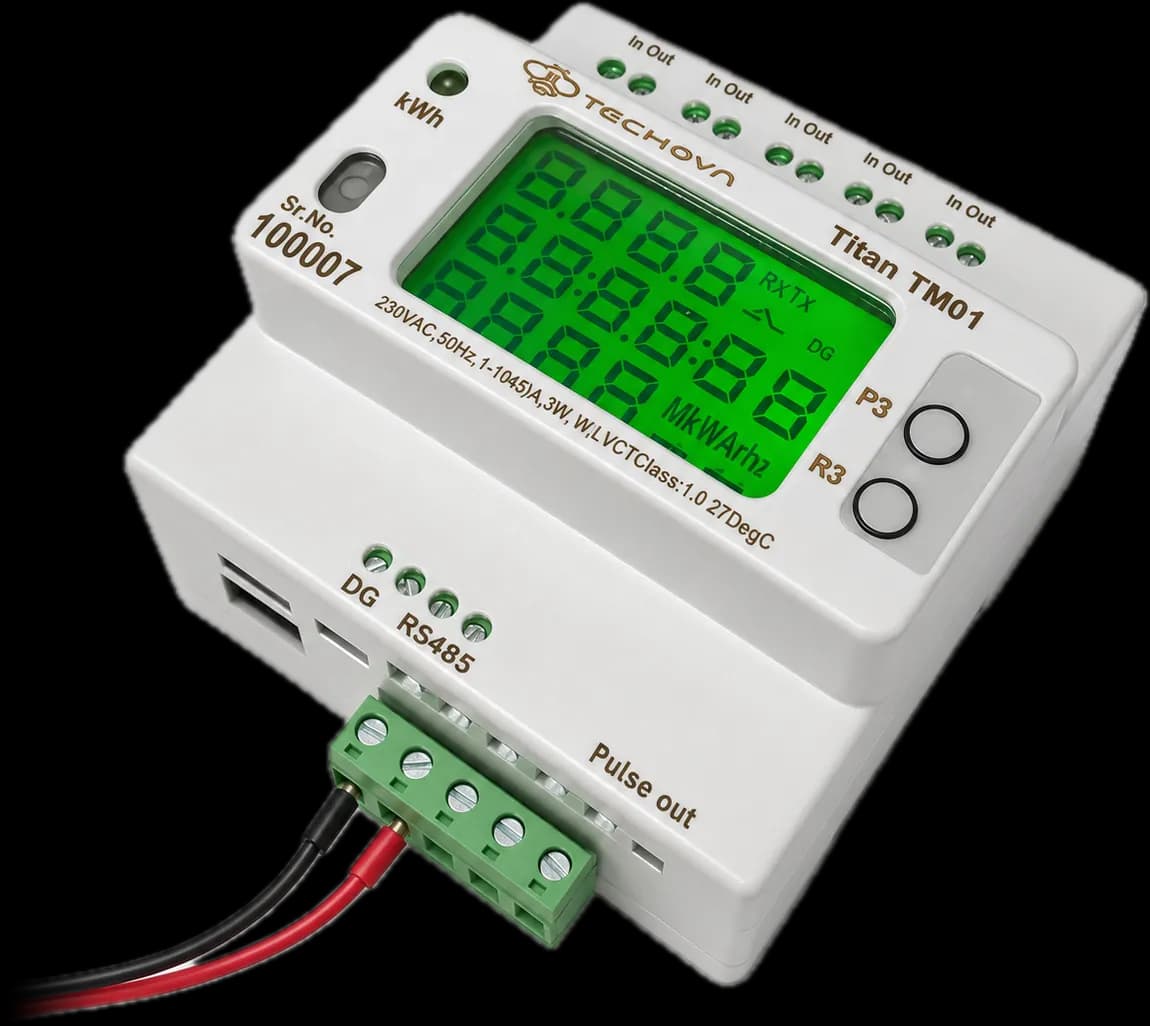
A remote pump monitoring system reports a pump's supply, running state and faults to a central dashboard. The Titan Pump RMS does this over 4G LTE with 2G fallback for tubewells, pumping stations and irrigation schemes, measuring every phase at Class 0.5S and detecting dry run, overload, phase failure and failure-to-start without changing how the existing starter works.
Trusted by energy & industrial leaders






At a glance
- What it is
- A 4G remote monitoring system (RMS) for water pumps — one unit per pump, mounted in the existing starter panel, reporting supply, run status, run hours, dry run and faults to a central dashboard.
- Best for
- Tubewells and borewells, village and municipal water-supply schemes, pumping stations, lift irrigation, solar pumps, and any pump fleet spread across sites nobody visits daily.
- How
- Titan Class 0.5S electrical measurement plus a starter-command digital input. No flow meter required; pressure, level and flow inputs optional where a site needs them.
- Monitoring first, control optional
- Measurement wires in parallel with the existing starter, so the pump keeps operating exactly as it does today. A contactor control output adds remote start/stop and fault trip on the same unit — wire it, or leave it out.
The Pump Is 40 km Away. Nobody Knows It Stopped.
A tubewell fails on Monday. The contactor is dead, or the supply never came, or the motor is running dry. Nobody finds out until Wednesday, when a village complains about water — and even then the first hour on site is spent working out which of those three it was. Meanwhile the logbook says the pump ran six hours a day all week, because the logbook is written from memory at the end of the month.
The information that would have prevented that is entirely electrical, and it is already present at the panel. Whether supply arrived. Whether the contactor pulled in. Whether the motor drew load. Whether that load matched a pump moving water. Nothing about it requires a flow meter, a site network, or rewiring the starter.
The Titan Pump RMS reads exactly that, at every pump, and reports it over 4G — so the question stops being “is the pump running?” and becomes “which four of my three hundred pumps need attention this morning?”
Ten Questions It Answers, From One Panel-Mounted Unit
Each of these comes from measurement at the starter panel — no flow meter, no site visit, no operator input.
| What you need to know | How the RMS knows it | What you get |
|---|---|---|
| Is electricity available at the pump? | Continuous per-phase voltage measurement at the panel incomer. Loss of supply is reported by the unit's own backed-up power before it shuts down. | Supply failed / supply restored, with timestamp |
| Is the pump ON or OFF right now? | Motor current above the learned no-load threshold — the pump is drawing load, so it is genuinely running, not merely switched on. | Live ON/OFF state on the dashboard |
| When did it start and when did it stop? | Every ON/OFF transition is time-stamped on-device against a battery-backed RTC, so times are correct even during a network outage. | Start time, stop time, cycle duration, start count |
| How long did it run today? | Run hours accumulated on-device per day, per week and per month, alongside kWh consumed for the same period. | Daily / monthly running-hour and energy report |
| Is the pump running dry? | Under-power against the pump's learned wet-load baseline, held over a confirmation window. Optionally cross-confirmed with a pressure or level input. | Dry-run alarm — and a trip, if the contactor control output is wired |
| Is the motor overloaded? | Over-current against the motor's nameplate FLC, with a time-over-current characteristic so start-up in-rush does not raise a false alarm. | Overload alarm with the current profile attached |
| Has a phase failed? | Per-phase voltage and current monitoring detects a missing phase, phase reversal and single-phasing while the motor is running. | Phase failure / phase reversal alarm |
| Is the voltage abnormal? | Over-voltage, under-voltage, voltage unbalance and frequency deviation, each with a configurable threshold and time delay. | Voltage abnormality alarm + duration log |
| Is the current abnormal? | Current unbalance between phases, under-current, and sudden step changes that indicate a jammed impeller, worn bearing or clogged suction. | Current abnormality alarm + trend |
| Was the pump commanded ON but is not operating? | A digital input reads the starter command or contactor auxiliary contact. Command present with no motor current means the contactor, starter, capacitor or motor has failed. | Pump failed to start — the alarm that matters most |
Every event is time-stamped on-device against a battery-backed clock and buffered locally, so an alarm raised during a network outage still arrives — with the time it actually happened, not the time it was finally delivered.
Dry-Run Monitoring for a Borewell Pump — Without a Sensor in the Well
Dry running is what kills submersible pumps: with no water to cool and lubricate it, a borewell pump destroys its seals and bearings within minutes. At a remote site the usual answer — a float, a probe, a pressure switch — means a sensor down the bore, a cable up it, and a maintenance liability at every one of your sites.
The electrical signal is already there. A pump moving no water does far less work, so the motor draws measurably less power than it does when primed — typically 15% to 40% less on a submersible. The Titan Pump RMS uses that:
- →It learns the baseline — the normal wet-load power draw of that specific pump at its own duty point, rather than relying on a fixed threshold that fits no pump in particular.
- →It measures power, not current — raw current moves with supply voltage, so on a weak rural feeder a voltage dip can look exactly like a dry pump. Power does not make that mistake.
- →It waits before alarming — the power must stay in the dry band for a configurable confirmation window, so an air pocket or a momentary loss of prime does not produce a false alarm at 3 a.m.
The honest limit
Current-based dry-run detection is inferential. It is excellent on submersibles and most centrifugal pumps, where the power drop is large and unambiguous. On a pump with an unusually flat power curve the margin narrows — so where certainty matters, add the optional 4–20 mA pressure or level input and the RMS will require both signals to agree before it acts. Whether a confirmed dry run raises an alarm or also stops the pump is your choice: wire the contactor control output and it trips, leave it unwired and it reports. If the pump should also start and stop itself on a pressure setpoint or tank level, that is the Titan Pump Controller.
Built for Five Hundred Pumps, Not for One
Monitoring one pump is a gadget. Monitoring a district is an operating system — it has to survive patchy networks, unmanned sites, and a control room with two people in it.
One Exception Dashboard
Nobody scrolls through 500 healthy pumps. The dashboard leads with the exceptions — pumps that failed to start, ran dry, tripped, lost supply, or have not reported in — so a two-person control room can run a district-wide scheme.
Site, Zone and Scheme Hierarchy
Group pumps by village, ward, zone, feeder, scheme or contractor. Run-hour and energy roll-ups at every level, so you can compare pumping stations against each other rather than reading them one at a time.
Alerts That Reach the Field
App push, email and SMS to the operator, the JE and the contractor — routed by site, with escalation if nobody acknowledges. Alarm and acknowledgement are both logged for accountability.
Offline Detection & Backfill
If a unit stops reporting it is flagged as offline rather than assumed healthy. Data logged during the outage is buffered on-device and backfilled on reconnect, so run-hour records stay complete.
Supply-Availability Reporting
Because the unit measures the incomer, you also get a record of how many hours grid supply was actually available at each site — the number that explains most water-supply shortfalls, and the one nobody can otherwise prove.
Tamper & Site Events
Panel-door open, unit power-down, CT disconnection and configuration change are logged as events with timestamps — useful where pumps are unattended and shared between users.
No Flow Meter? You Can Still Run the Scheme.
Most of what a water-supply operation needs day to day is not volume — it is whether the pump ran, for how long, and whether anything went wrong. All of that is electrical, and all of it works with no flow meter anywhere on the site.
Where volume is genuinely needed, the RMS estimates it as run hours against the pump's rated discharge at its duty point. That number is good enough to compare one village against another, to spot a pump whose output is falling as it wears, and to size the next phase of a scheme. It is an estimate, not a measurement — it should not be used for billing or statutory water accounting, and we will say so in the tender documentation rather than let it be claimed otherwise.
When measured volume is required, the RMS takes a pulse input from the flow meter you already have — and then the interesting number appears: litres per kWh, per pump, trended over months. That is the number that shows a pump quietly losing efficiency long before it fails.
Technical Specifications
Measurement, detection, connectivity and installation — one DIN-rail unit per pump.
Measurement
| Parameter | Specification |
|---|---|
| Metering accuracy | Class 0.5S active energy (IEC 62053-22) — the same measurement engine as the Titan energy meter |
| Phases | Single-phase and three-phase (3-phase 4-wire / 3-wire) |
| Voltage | 57.7 V to 277 V per phase — covers 230 V single-phase and 400/415/440 V three-phase systems |
| Current | CT-operated, CT primary 10 A – 1000 A. Split-core CTs available so a live pump can be instrumented without a shutdown |
| Measured | Per-phase voltage, current, kW, kVA, power factor, frequency, kWh, phase unbalance |
| Derived | ON/OFF state, start/stop timestamps, run hours, start count, cycles per day, energy per run, litres pumped (estimated), specific energy (kWh per hour run) |
Detection, Alarms & Logging
| Parameter | Specification |
|---|---|
| Supply monitoring | Supply present / failed / restored, per phase, with time-stamped outage duration |
| Motor protection events | Overload (time-over-current), under-current, phase failure, phase reversal, voltage and current unbalance, over/under-voltage, over/under-frequency |
| Dry-run detection | Under-power against a learned wet baseline, with a configurable confirmation window; optional cross-confirmation from a pressure or level input |
| Failure-to-start detection | Starter command present (digital input) with no motor current for the set delay — flags contactor, starter, capacitor or motor failure |
| Health trending | Rising power draw against baseline for the same run — the early signature of bearing wear, impeller wear or a clogging strainer |
| Event log | On-device time-stamped event and alarm log, retained through power failure and network outage |
| Thresholds | All thresholds and delays configurable per site, remotely, without a site visit |
Connectivity & Integration
| Parameter | Specification |
|---|---|
| Cellular | 4G LTE with 2G fallback, internal SIM (multi-operator M2M SIM supplied on request), external screw-on antenna for panel-mounted installations |
| Reporting | Scheduled telemetry at a configurable interval (default 5 minutes) plus immediate push on any alarm or state change |
| Protocols | MQTT over TLS and HTTPS push to the Tech OVN cloud, to your server, or to both simultaneously |
| Local bus | RS485 Modbus RTU for a local panel HMI, PLC or an on-site SCADA RTU |
| Store and forward | On-device logging when the network is unavailable, automatically backfilled on reconnect |
| Dashboard & app | Live status, map and list views, alarms, run-hour and energy reports through the Titan App and the Energy Intelligence Platform |
| Firmware | Over-the-air (OTA) firmware and configuration updates across the whole fleet |
Inputs, Power & Installation
| Parameter | Specification |
|---|---|
| Digital inputs | 2 × volt-free digital inputs — starter command / contactor auxiliary contact, and a level float or spare site contact |
| Analogue input (optional) | 4–20 mA pressure or level transmitter, for pressure cross-confirmation of dry run and for tank-level reporting |
| Pulse input (optional) | Flow-meter pulse input where a flow meter already exists and volume must be measured rather than estimated |
| Contactor control output | Control output that drives the existing starter's relay or contactor coil — for remote start/stop from the dashboard and for a dry-run or fault trip. Wire it only where the site permits control; leave it unwired for pure monitoring |
| Power supply | Powered from the incoming supply, with internal backup sufficient to transmit a supply-failure message after the mains drops |
| Timekeeping | Battery-backed real-time clock with network time sync — timestamps stay correct through extended outages |
| Mounting | DIN rail inside the existing starter panel, or supplied in an IP65 wall-mount enclosure for panels with no spare space |
| Installation impact | Measurement is wired in parallel with the existing starter, so the pump keeps running exactly as it does today. The control circuit is only touched if you choose to wire the contactor control output |
In development
The Titan Pump RMS is being introduced on the proven Titan metering platform. Talk to our engineering team about pilot units, CT selection for your motor ratings, antenna and enclosure options for your site conditions, and SIM and platform commercials for the fleet size you are planning.
RMS vs Phone Calls vs a kWh Logger vs SCADA
Most pump fleets are monitored by one of three things: an operator who phones in, an energy meter that only counts units, or a SCADA panel that was affordable at one site and impossible at three hundred.
| Capability | Titan Pump RMS | Operator phone calls | Energy meter / kWh logger | SCADA RTU panel |
|---|---|---|---|---|
| Knows if the pump is actually running | Yes — from motor current | Only when someone visits | Infers from kWh, coarsely | Yes |
| Knows if grid supply is available | Yes — reported on failure | No | Ambiguous — no data either way | Yes |
| Pump commanded ON but not running | Yes — dedicated alarm | No | No | If programmed |
| Dry-run detection | Yes — power baseline (+ optional sensor) | No | No | With added sensors |
| Start/stop times and daily run hours | Yes — automatic | Handwritten logbook | Partial | Yes |
| Works over 4G at unmanned rural sites | Yes — built in | n/a | Usually needs a gateway | Needs added modem |
| Cost per site | Low — single device | Recurring labour | Low, but incomplete | High |
| Install without disturbing the starter | Yes — parallel wiring | n/a | Yes | No — panel rework |
| Scales to hundreds of sites | Yes — fleet dashboard | No | Manually | Expensive |
RMS or Pump Controller — which one do you need?
Titan Pump RMS (this page) watches the pump, and commands it when you ask. Choose it when the starter panel already works and must not be re-engineered, when the site is remote and needs 4G, and when the requirement is visibility across many sites — with remote start/stop and a fault trip through its contactor control output.
Titan Pump Controller decides for itself when to run the pump. Choose it when you want automatic operation on a pressure setpoint or tank level, with lead-lag rotation across a twin-pump set, replacing the relays inside the panel. Both share the same metering engine and the same dashboard.
Where It Is Used
Anywhere a pump matters and nobody is standing next to it.
Village Water Supply & Tubewells
Scheme-wide visibility of every borewell and tubewell — whether power came, whether the pump ran, for how long, and whether it ran dry. The run-hour record replaces the operator's logbook and settles disputes about supply hours.
Municipal Pumping Stations
Intake, transmission, booster and sewage pumping stations reporting into one control room, with duty/standby run-hour balance visible per station and failure-to-start alarms escalated to the maintenance contractor.
Irrigation & Lift Schemes
Widely spread lift-irrigation and canal pumps where a site visit costs half a day. Run hours per season, energy per hour of pumping, and unauthorised-operation alerts outside the sanctioned window.
Solar Pumps
Monitoring on the VFD output to the motor for solar pumping systems — daily run hours, effective pumping window, dry-run events and controller faults across a distributed installation base.
Industrial & Utility Pumps
Cooling-water, effluent, process and dewatering pumps inside a plant, feeding the same dashboard as the site's energy metering — so pump energy is auditable alongside every other load.
Building & Estate Water Systems
Underground-to-overhead transfer pumps, boosters and STP pumps across a campus or a portfolio of buildings, monitored centrally instead of by the site electrician noticing.
Bidding a Government Water, Irrigation or Municipal Project?
Most RMS and IoT-based water-supply monitoring tenders are won by integrators and IT firms, not by hardware companies — and the field device is usually the part of the bid nobody wants to own. We are happy to be that part, and only that part.
Tech OVN supplies the field hardware and the data interface. You keep the SCADA, the dashboard, the citizen app, the system integration and the client relationship. We do not bid against our integration partners for the software scope of these projects.
What we supply
The monitored field unit, CTs and sensors, SIMs if you want them bundled, firmware and OTA management, the documented data interface, and factory support for site commissioning and warranty across the deployment.
What stays yours
The SCADA or command-and-control centre, the dashboards and reports, the citizen-facing app, the department integration, the hosting, and the branding. The device can report to your endpoint alone — it does not have to touch our cloud at all.
How the data reaches you
MQTT over TLS to your broker, or JSON pushed over HTTPS to your endpoint, or Modbus RTU on RS485 into a local RTU where the design calls for one. Documented topic scheme, register map and payload schema, with runnable examples on our public integration repository so your team can build against it before award.
Made in India, supplied at scale
Units are built at our Delhi NCR facility, so quantity, phased delivery against a rollout schedule and long-term spares support are a manufacturing conversation rather than an import one. Talk to us at bid stage — the specification usually needs a technical read before it is frozen.
RMS for Water Pumps, GSM Pump Monitoring, IoT Water Supply — One Device
The same requirement arrives under a dozen names. A water board writes a specification for an RMS for water pumps or a remote monitoring system for pumping stations. A consultant asks for an IoT based water supply monitoring system as part of smart water supply management. A panel builder calls it a GSM pump monitoring system, because that is what it was called when it ran on 2G. An irrigation department wants tubewell remote monitoring with dry run monitoring of borewell pumps. A solar EPC wants a remote monitoring system for solar pumps. A maintenance head simply wants pump running hour monitoring he can trust.
All of them are the same device and the same pump operation monitoring dashboard: one 4G unit per pump, measuring the electrical side at the starter panel, reporting supply availability, run status, run hours, dry run and faults to a central pump status monitoring system — with nothing installed in the water and nothing changed in the control circuit.
Because it is built on the Titan metering engine, the pump data lands in the same Energy Intelligence Platform as the rest of your electrical assets — so pumping energy sits alongside condition monitoring and energy monitoring for everything else on the site.
Built on the Titan Family
The same Class 0.5S accuracy, the same dashboard and the same compact DIN-rail form factor as the rest of the Titan range.
| Product | Description | Status |
|---|---|---|
| TITAN | Core smart energy meter. WiFi + Ethernet + RS485 | Active |
| TITAN AUDIT | Rapid deployment logger. Split-core CT, plug & play | Active |
| TITAN EV | EV charge controller. OCPP 2.0.1, IEC 61851 | Active |
| TITAN PQ | Power quality meter. Harmonics, sags, swells, flicker, transients | 4 weeks from PO |
| TITAN ASSET | Condition monitoring. Energy + vibration + temperature | 4 weeks from PO |
| TITAN PLUS BTU | Chiller efficiency meter. kW/TR + BTU on a single device | 4 weeks from PO |
| TITAN BTU | BTU meter. Chilled water, hot water, district cooling | 4 weeks from PO |
| TITAN COMPLIANCE | Fire pump monitoring. NFPA 25 + IS 15301 compliance | 4 weeks from PO |
| TITAN PUMP | Pump controller. Dry-run protection + energy monitoring + remote start | 4 weeks from PO |
| TITAN PUMP RMSYou are here | Remote pump monitoring. 4G, run hours + dry run + fault alerts | 4 weeks from PO |
| TITAN BLOWER | Blower controller. Filter-clog + over-pressure protection + energy monitoring | 4 weeks from PO |
Frequently Asked Questions
Remote pump monitoring, dry-run detection from current, monitoring without a flow meter, and running a fleet of hundreds of pumps.
Supply and installation
Need it fitted across sites rather than shipped in a box? Site survey, installation, commissioning and annual maintenance are available through Trading Engineers, our supply and service partner within the OVN Engineers group.
Stop finding out from the village
Talk to our engineering team about a Titan Pump RMS pilot — supply availability, run hours, dry run and failure-to-start on your pumps, over 4G.