
Fire Pump Monitoring System — Titan Compliance
Automate What Your Logbook Can't.
DIN rail fire pump monitoring system combining energy metering, pressure sensing, and flow measurement. Auto-logs pump tests, flags missed tests, surfaces pressure-loss leaks via jockey-pump cycling, and produces inspector-ready PDF reports.
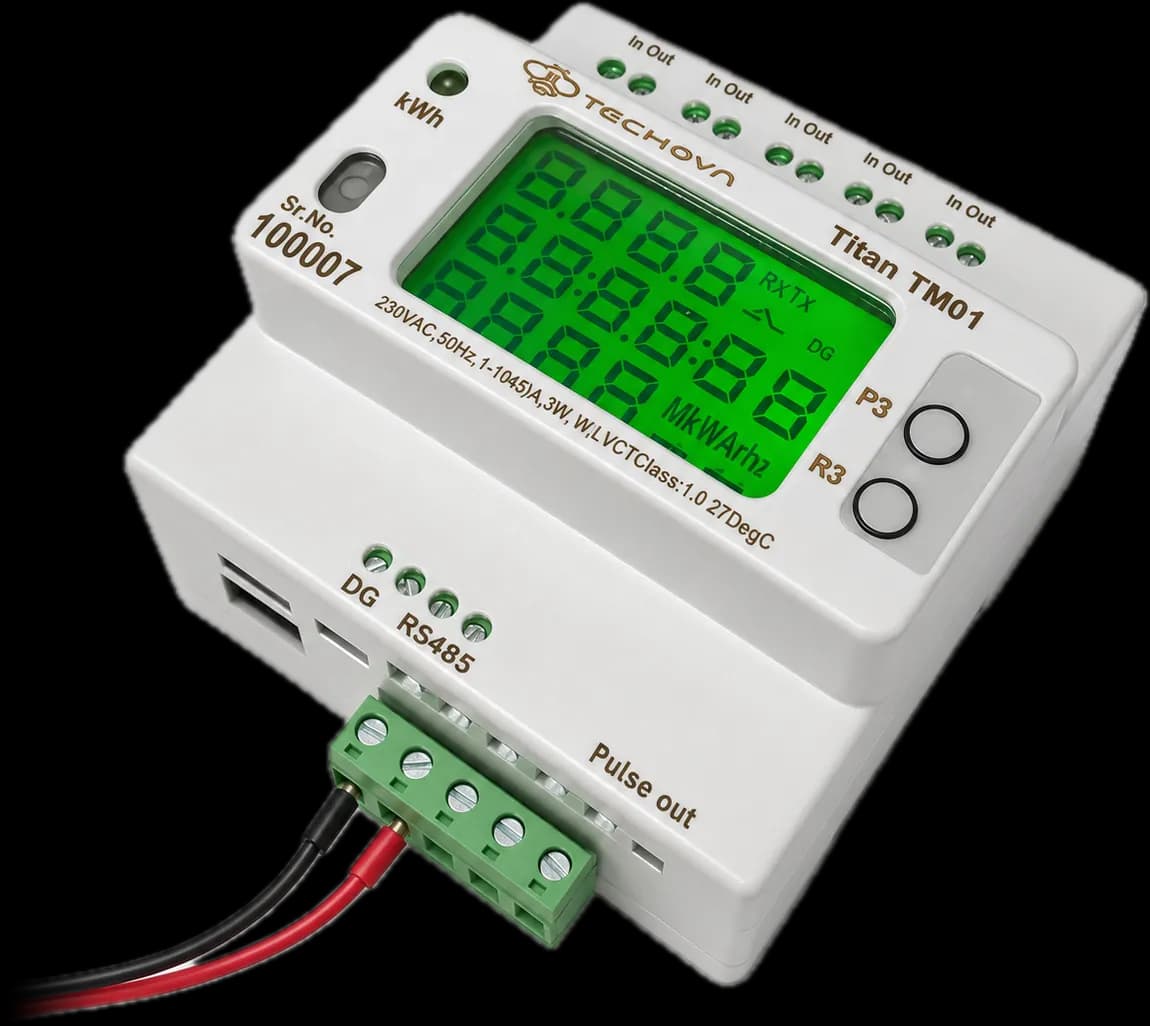
Titan Compliance is a DIN-rail fire pump monitoring system that combines a Class 0.5S energy meter with pressure sensors and an inline ultrasonic flow meter. It is for building management companies and fire protection contractors, and it detects pump runs from their electrical signature for NFPA 25 and IS 15301 test records. Indicative price is ₹9,500 to ₹12,500 per unit.
Trusted by energy & industrial leaders






At a glance
- What it is
- A DIN-rail fire-pump monitoring system — energy meter + pressure sensors + inline flow meter on one device, with automated weekly/monthly test logging.
- Best for
- Building management committees, fire-protection contractors, high-rise facility managers, and compliance officers running NFPA 25 / IS 15301 test programmes.
- Standards
- NFPA 25, IS 15301, IS 12469, NBC 2016 Part 4. Inspector-ready PDF test logs auto-generated from sensor data.
- Interfaces
- Class 0.5S energy meter, pressure transducer inputs, inline flow meter. WiFi + Ethernet + RS485 (Modbus RTU/TCP, BACnet MS/TP, BACnet/IP). Email alerts on missed tests and jockey-pump cycling.
What a Fire Pump Monitoring System Does
Three things every BMC, fire-protection contractor, and high-rise facility manager needs from fire-pump telemetry — none of them handled by the pump control panel alone.
Automated Test Logging
The energy meter detects when the fire pump runs, logs duration, electrical parameters, and pump-side flow rate captured by the integrated flow meter. No stopwatch and no logbook entries.
Missed Test Warnings
If a scheduled weekly or monthly test is not detected within its window, Titan Compliance sends an email warning to the facility manager and compliance officer.
Pressure-Loss & Cycling Alerts
Pressure sensors track sustained system pressure. Abnormal jockey-pump cycling frequency is the earliest indicator of a sprinkler-system leak — Titan Compliance flags it before the inspector does.
The Problem
Fire pump compliance is currently manual. A technician runs the pump, writes the result in a logbook, and someone compiles a report for the fire inspector. Pumps that develop faults between tests go undetected. Missed tests create compliance gaps that surface only at the next NOC renewal. Handwritten logs are inconsistent. And nobody tracks whether the jockey pump is cycling too often — the earliest sign of a sprinkler-system leak.
Titan Compliance does not replace the testing — it ensures every test is recorded properly, every missed test is flagged, and every pressure-loss anomaly is caught.
NFPA 25 & Indian Standards — IS 15301, IS 12469, NBC 2016
Fire-pump monitoring sits at the intersection of NFPA 25 (the international ITM standard) and the Indian regulatory framework (IS 15301 + IS 12469 + NBC 2016 Part 4). Titan Compliance is designed to produce evidence accepted by inspectors and auditors working under any of these.
International
NFPA 25 — Inspection, Testing & Maintenance of Water-Based Fire Protection
- Weekly no-flow churn test for diesel-driven pumps; monthly for electric-driven.
- Annual flow test at minimum, rated, and peak load — performance verified against pump curve.
- Records of every test, including duration, suction & discharge pressure, flow, and any abnormalities.
India
IS 15301, IS 12469 & NBC 2016 Part 4
- IS 12469 — specification for centrifugal pumps for fire-fighting service.
- IS 15301 — Code of Practice for installation and maintenance, including periodic testing intervals.
- NBC 2016 Part 4 — fire-pump-room requirements, minimum 3.5 kg/cm² at the remotest point, ongoing monitoring.
How It Works
Install Titan Compliance on the fire pump's electrical supply with pressure transducers on the system manifold and an inline flow meter on the pump discharge. From there it monitors continuously and detects every pump run automatically.
Continuous Monitoring
24/7 on the fire-pump supply, pressure, and flow
Event Detection
Pump start auto-recognised from electrical signature
Automated Logging
Duration, electrical parameters, flow, pre/post pressure
Reports & Alerts
Inspector PDF + missed-test and cycling warnings
What It Measures
Three sensor inputs map directly to the evidence that NFPA 25 and IS 15301 require. Nothing more is claimed than these inputs can actually deliver.
Energy Meter
Pump-run detection & logging
Auto-detects pump starts from the electrical signature, records duration, kWh, voltage, current, power factor, and power-cycle events. Distinguishes scheduled tests from emergency runs by run-pattern context.
Pressure Sensors
System health & leakage signal
Continuous suction- and discharge-side pressure history. Used to verify system pressure pre/post test, count jockey-pump cycles, and flag cycling-rate drift that signals a leak in the suppression network.
Flow Meter
Annual flow-test verification
Records flow rate during each test. The annual NFPA 25 flow test compares measured discharge against the rated pump curve at minimum, rated, and peak load — Titan Compliance produces the data table the inspector needs.
Specifications
Everything an MEP consultant, fire-protection contractor, or facility engineer needs to spec Titan Compliance into a pump-room retrofit or new high-rise design.
Measurement & Sensor Inputs
| Parameter | Specification |
|---|---|
| Standards | NFPA 25 · IS 15301 · IS 12469 · NBC 2016 Part 4 |
| Sensor Inputs | Energy meter + pressure sensor(s) + inline flow meter |
| Phases Supported | 3-phase or 3 × single-phase fire pump configurations |
| Energy Meter Accuracy | Class 0.5S (active) per IEC 62053-22 |
| Voltage Range | 48V to 500V AC |
| Current Range | 100A / 200A / 400A / 800A via LVCT |
| Pressure Range | 0 to 25 bar (0 to 25 kg/cm²) — covers typical sprinkler & hydrant systems |
| Flow Meter | Inline ultrasonic, sized to discharge line |
| Operating Temperature | −10°C to +60°C (pump-room rated) |
Test Logging, Alerts & Reporting
| Parameter | Specification |
|---|---|
| Pump-Run Detection | Auto-recognised from electrical signature; logs duration, kWh, V, I, PF, flow |
| Test Schedule | Weekly (diesel-driven) / monthly (electric-driven) per NFPA 25 |
| Missed-Test Alert | Email notification if scheduled window passes without a detected run |
| Jockey-Pump Cycling | Continuous count + drift alarm — flags sprinkler-system pressure leaks |
| Inspector PDF Report | Auto-generated per test run; format aligned to fire-NOC and TAC audits |
| Annual Flow-Test Data | Records flow rate at minimum, rated, and peak load against pump curve |
Connectivity, Integration & Mounting
| Parameter | Specification |
|---|---|
| Communications | WiFi · Ethernet · RS485 |
| Protocols | Modbus RTU/TCP · BACnet MS/TP · BACnet/IP · MQTT |
| Cloud Platform | Energy Intelligence Platform — fire-compliance dashboard, multi-site portfolio view |
| BMS / SCADA | All measured parameters exposed over Modbus or BACnet for 3rd-party integration |
| Mounting | DIN rail (35mm) — installs in existing fire-pump panel or sub-board |
| Indicative Price (India) | ₹9,500 – ₹12,500 per unit, depending on sensor configuration |
Datasheet (PDF): Titan Compliance datasheet
How Titan Compliance Compares
The four ways buildings handle fire-pump compliance today — and where each one fails the inspector or the insurer.
| Capability | Titan Compliance | Manual Logbook | Pressure Switch Only | Generic BMS Module |
|---|---|---|---|---|
| Auto-detects pump runs | Yes — electrical signature | No — technician must record | No — only senses pressure | Sometimes — depends on integration |
| Logs duration + electrical params | Yes — every run | Manual entry, error-prone | No | Partial — needs add-on metering |
| Annual flow-test data capture | Yes — built-in flow meter | Manual gauge reading | No | Rarely included |
| Missed-test alerts | Email + dashboard | No — found at NOC renewal | No | Configurable, often unset |
| Jockey-pump cycling drift alarm | Continuous, with baseline | No | Counts cycles only, no leak signal | No |
| Inspector-ready PDF | Auto-generated per test | Hand-compiled before inspection | Not applicable | Custom reporting build required |
| NFPA 25 + IS 15301 alignment | Designed against both | Depends on technician | Not in scope | Generic — not fire-pump-specific |
| Integration with BMS / SCADA | Modbus RTU/TCP, BACnet, RS485, MQTT | None | Dry contact only | Yes (its native role) |
| Time-to-deploy | Hours — DIN rail retrofit | Already in place | Hours — but no records | Weeks — engineering project |
Who It's For
Two groups deploy fire-pump monitoring most often.
Building Management Companies
Automated compliance documentation across your portfolio. Inspector-ready PDF reports generated each time a test is performed — no more chasing logbooks.
Fire Protection Contractors
Offer continuous monitoring as a service. Get alerted to missed tests and pressure-system leaks before the next inspection — not during it.
Energy Intelligence Platform
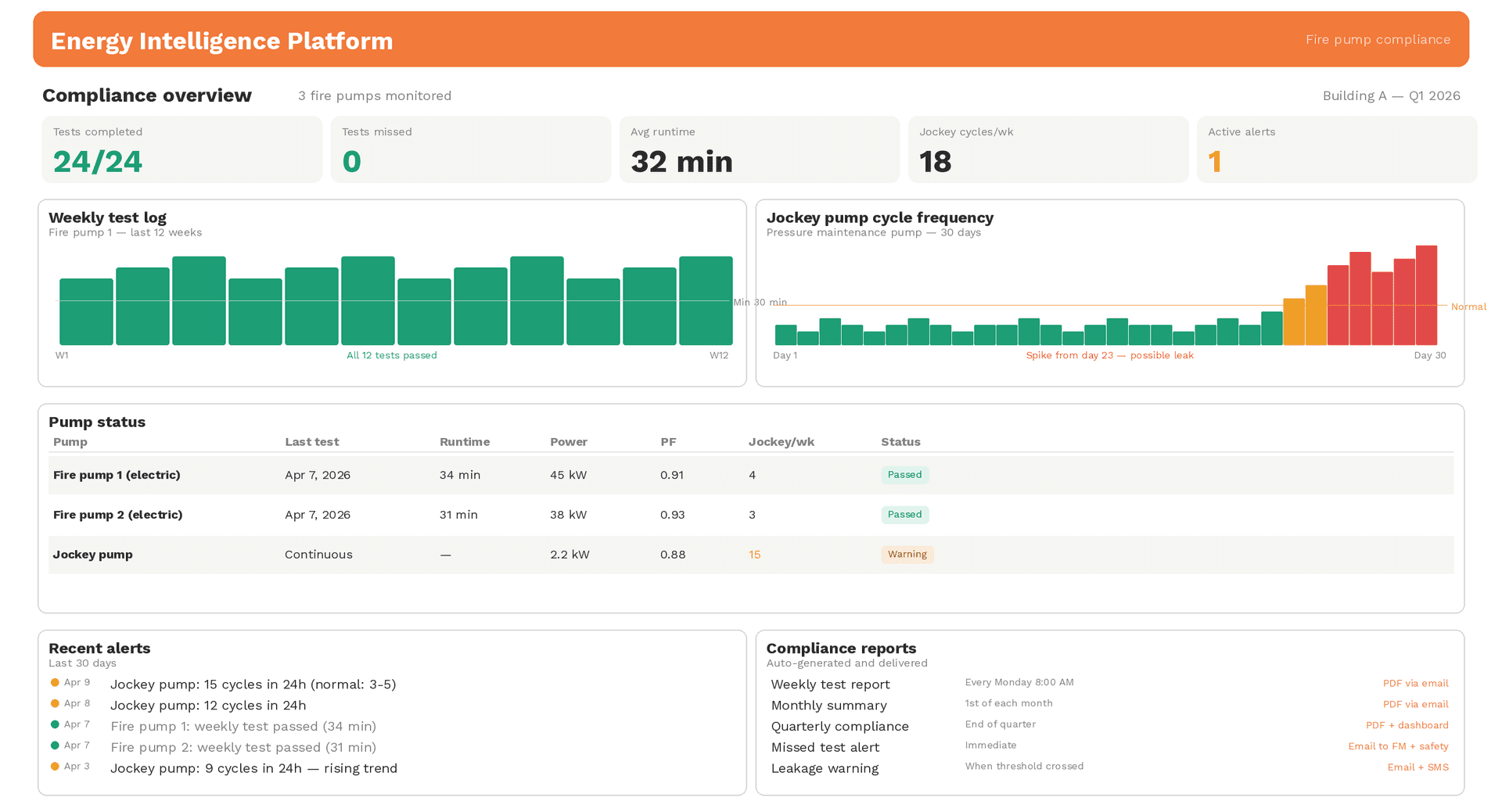
Titan Compliance pairs with the Energy Intelligence Platform for automated test logging, missed-test alerts, jockey-pump cycling detection, and inspector-ready PDF generation. Every fire-pump event is recorded, every missed test is flagged, and every report is generated and delivered automatically. Modbus RTU/TCP integration is also available for sites that prefer to land the data directly in an existing BMS or SCADA.
Free Resource — Fire Pump Test Log Template
Run your weekly tests with our free template alongside Titan Compliance — NFPA 25, IS 15301, and NBC 2016 Part 4 aligned, with all the columns a fire-NOC inspector or TAC auditor will check.
Get the Fire Pump Test Log →Frequently Asked Questions
Common questions about NFPA 25 testing, Indian standards (IS 15301 / IS 12469 / NBC 2016), jockey-pump cycling, and BMS integration.
The Titan Family — One Platform, Eight Applications
The same accuracy, connectivity, and design language across the full metering range.
| Product | Description | Status |
|---|---|---|
| TITAN | Core smart energy meter. WiFi + Ethernet + RS485 | Active |
| TITAN AUDIT | Rapid deployment logger. Split-core CT, plug & play | Active |
| TITAN EV | EV charge controller. OCPP 2.0.1, IEC 61851 | Active |
| TITAN PQ | Power quality meter. Harmonics, sags, swells, flicker, transients | 4 weeks from PO |
| TITAN ASSET | Condition monitoring. Energy + vibration + temperature | 4 weeks from PO |
| TITAN PLUS BTU | Chiller efficiency meter. kW/TR + BTU on a single device | 4 weeks from PO |
| TITAN BTU | BTU meter. Chilled water, hot water, district cooling | 4 weeks from PO |
| TITAN COMPLIANCEYou are here | Fire pump monitoring. NFPA 25 + IS 15301 compliance | 4 weeks from PO |
| TITAN PUMP | Pump controller. Dry-run protection + energy monitoring + remote start | 4 weeks from PO |
| TITAN PUMP RMS | Remote pump monitoring. 4G, run hours + dry run + fault alerts | 4 weeks from PO |
| TITAN BLOWER | Blower controller. Filter-clog + over-pressure protection + energy monitoring | 4 weeks from PO |
How to Buy Titan Compliance
Order quantities, lead time and warranty for a fire-pump compliance deployment.
| Parameter | Specification |
|---|---|
| Indicative price (India) | ₹9,500 – ₹12,500 per unit, depending on sensor configuration. |
| MOQ — catalogue | None. A single unit is a valid order, so a pilot or an evaluation order is one unit. |
| Lead time | 4 weeks from confirmed PO. |
| Warranty | 2 years standard from date of dispatch. |
| Cloud dependency | None required. Modbus RTU/TCP and BACnet are local and work with no internet connection; the Tech OVN platform is optional. |
| Manufacturing | Designed, built, calibrated and tested in Delhi NCR, India. |
Ready to Automate Fire Pump Compliance?
Talk to an engineer about deploying Titan Compliance across your building portfolio, fire-protection contracts, or insurance reporting workflow.