
Solution
IoT Energy Meter — WiFi, Cloud, No Gateway
IoT-Based Smart Energy Meter for Industrial India.
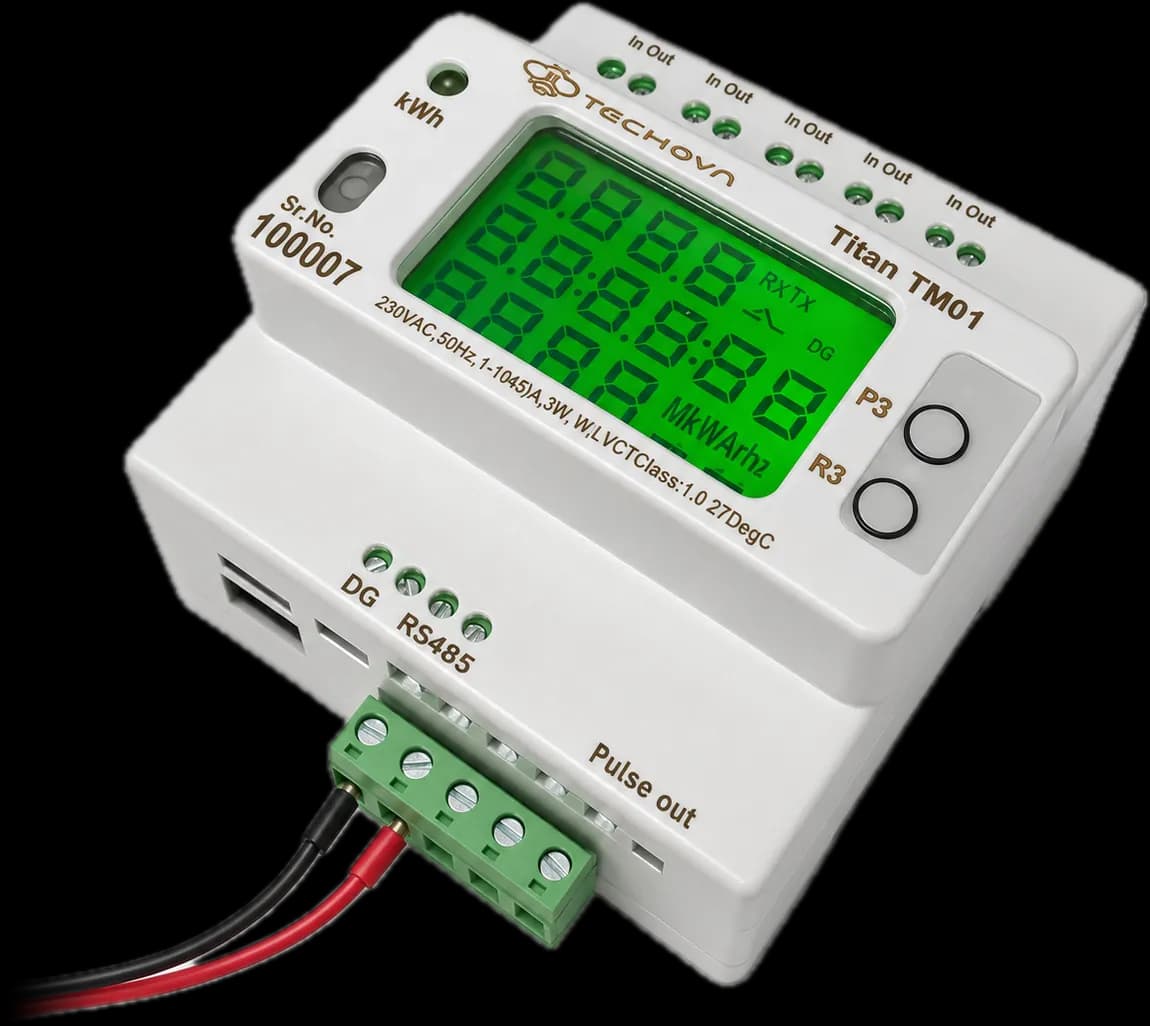
Titan is an IoT energy meter — a smart energy meter using IoT connectivity with built-in WiFi and Ethernet, no gateway needed. Class 0.5S accuracy, MQTT and Modbus protocols, edge computing on-device, and OTA firmware updates. Connect to any cloud platform or use the Tech OVN cloud Energy Management System (EMS) for turnkey remote energy monitoring.
Why an IoT-Based Smart Energy Meter?
Six reasons Titan replaces traditional meters and gateways with a single connected IoT energy meter.
Built-In WiFi + Ethernet
No external gateway or data concentrator to fail. Each Titan meter connects directly to the cloud over WiFi or Ethernet — plug in, configure from the app, and data flows.
MQTT + Modbus + BACnet
Publish energy data over MQTT for cloud-first architectures, or use Modbus RTU/TCP or BACnet MS/TP / BACnet/IP for BMS and SCADA integration. The network-side protocols (MQTT, Modbus TCP, BACnet/IP, REST API) run alongside whichever single role the RS485 port is set to.
Edge Computing On-Device
Data logging, demand profiling, TOU registers, and real-time alerts all run on the meter. If the internet drops, the meter continues logging and syncs when connectivity returns.
OTA Firmware Updates
Remote firmware updates over WiFi — no site visits, no USB cables. Roll out new features, security patches, and configuration changes across your entire meter fleet.
RS485 Bus Master
The RS485 port can be set as a Modbus RTU bus master, polling legacy Modbus devices (existing meters, sensors, PLCs) and forwarding their data to the cloud alongside its own measurements. RS485 runs one role at a time — Modbus RTU slave, Modbus RTU master or BACnet MS/TP — so in master mode a BMS reads the meter over the network side instead.
Open, Standard Protocols
Modbus, BACnet and MQTT are open industry standards — your data isn't trapped behind a proprietary protocol or a single paid cloud. Integrate with any BMS, SCADA, MQTT broker, or analytics platform you already run.
Communication Protocols — Modbus TCP, RS485 & MQTT
Titan is an internet-connected energy meter that speaks every protocol your stack needs — Modbus RTU or BACnet MS/TP over RS485 (one role at a time), and Modbus TCP, BACnet/IP and MQTT over Ethernet or WiFi running alongside it. Serve a local BMS or SCADA over Modbus or BACnet while streaming the same readings to the cloud over MQTT, with no gateway, converter, or data concentrator in between.
Modbus RTU over RS485
An RS485 energy meter for legacy BMS, SCADA, and PLC networks. Titan speaks Modbus RTU over a standard 2-wire RS485 bus, with full holding/input registers for voltage, current, power, energy, and power quality.
Modbus TCP over Ethernet
A Modbus TCP energy meter with a built-in Ethernet port — no RS485-to-Ethernet converter, no serial gateway. Poll Titan directly over your LAN at full speed from any Modbus TCP master, SCADA head-end, or building automation controller.
MQTT over WiFi / Ethernet
An MQTT energy meter that publishes to any broker — AWS IoT Core, Azure IoT Hub, HiveMQ, Mosquitto, or the Tech OVN cloud. Lightweight pub/sub for cloud-first IoT architectures, with configurable topics, QoS, and TLS security.
The Modbus register map, MQTT topics and command reference, and runnable Python examples are published as reference documentation in the Titan integration repository on GitHub.
Connectivity at a Glance
| Parameter | Specification |
|---|---|
| Field bus | 2-wire RS485 — one role at a time: Modbus RTU slave, Modbus RTU master or BACnet MS/TP |
| Wired IP | Modbus TCP and BACnet/IP over 10/100 Ethernet — no serial gateway required |
| Wireless IP | Built-in 2.4 GHz WiFi (802.11 b/g/n) |
| Cloud / pub-sub | MQTT to any broker (direct to AWS IoT Core or Azure IoT Hub, or HiveMQ, Mosquitto, Tech OVN cloud), TLS-secured |
| Simultaneous operation | The Ethernet/WiFi side (Modbus TCP, MQTT, REST API, BACnet/IP) runs alongside the RS485 role — serve local BMS/SCADA while streaming to the cloud |
| Cloud | Direct to the Tech OVN cloud / EMS over WiFi or Ethernet — no separate energy-server PC |
| Edge resilience | On-device logging (1–60 min) with automatic backfill when connectivity returns |
| Updates | OTA firmware over WiFi — no site visits, no USB |
Traditional Setup vs. Titan IoT
One device replaces the meter-gateway-SIM stack.
Traditional Meter + Gateway
Separate meter, separate gateway, separate SIM card, separate power supply. Multiple vendors, multiple failure points, multiple license fees. Data arrives 15 minutes late.
Titan IoT Energy Meter
Meter and connectivity in one device. WiFi or Ethernet built in. Data published over MQTT or polled over Modbus or BACnet in real time. One vendor, one device, one subscription.
Use Cases
From remote site monitoring to OEM integration — four ways facilities and product companies deploy Titan as an IoT energy meter.
Remote Energy Monitoring
Monitor unmanned sites — telecom towers, pump stations, transformer substations, retail stores — without local IT infrastructure. WiFi from a mobile hotspot or Ethernet from any available port.
Cloud Energy Monitoring
Stream energy data to AWS IoT Core, Azure IoT Hub, or any standard MQTT broker you run yourself. Build custom dashboards, ML models, and automated workflows on top of Class 0.5S meter data.
OEM Integration
Machine builders embed Titan meters for energy-as-a-feature. Publish per-machine energy data to your product cloud. Offer customers energy analytics as a value-add service.
Smart Building IoT
Integrate with building IoT platforms via MQTT, Modbus or BACnet. Feed energy data into occupancy-based HVAC control, lighting automation, and tenant billing systems.
Frequently Asked Questions
Common questions about IoT energy meters, cloud connectivity, and integration.
Related Solutions & Products
Use Titan as an IoT energy meter across energy monitoring, solar tracking, and commercial sites.
Energy Monitoring System
Circuit-level industrial energy monitoring with real-time dashboards, multi-site visibility, and CO₂ reporting.
Learn More →Solar Monitoring System
Measure solar generation, grid import/export, and diesel runtime on one dashboard — bi-directional IoT metering.
Learn More →Titan Smart Energy Meter
Class 0.5S DIN rail meter with built-in WiFi, Ethernet, RS485, and MQTT — the IoT energy meter hardware behind the solution.
Learn More →Multifunction meter (MFM)
3-phase Class 0.5S multifunction meter in a 96 × 96 mm panel housing. Measures kWh, kVAh, kVArh, PF and demand. ₹7,500 for the RS485-only model; ₹8,500–18,300 with full comms (Modbus TCP, MQTT).
Learn More →What an IoT Energy Meter Costs
Priced per measurement point, with no gateway or per-site licence to add.
| Parameter | Specification |
|---|---|
| Cost per measurement point | ₹8,500 – ₹18,300 per Titan meter, or from ₹7,500 for the RS485-only panel variant. |
| MOQ — catalogue | None. A pilot or an evaluation order can be one unit. |
| Lead time | Regular orders ship from stock; large quantities (200+ units) 4 weeks from confirmed PO. |
| Warranty | 2 years standard from date of dispatch. |
| Per-site infrastructure | None. WiFi and Ethernet are built into the meter — no energy-server PC, data concentrator or per-site software licence. |
| Cloud dependency | None required. Modbus RTU/TCP and BACnet are local and work with no internet connection; the Tech OVN platform is optional. |
Ready to connect your energy data?
Talk to our team about deploying Titan IoT energy meters in your facility, building, or product.