
Smart Pump Controller
Protect the Pump. Watch the Energy. Control It From Anywhere.
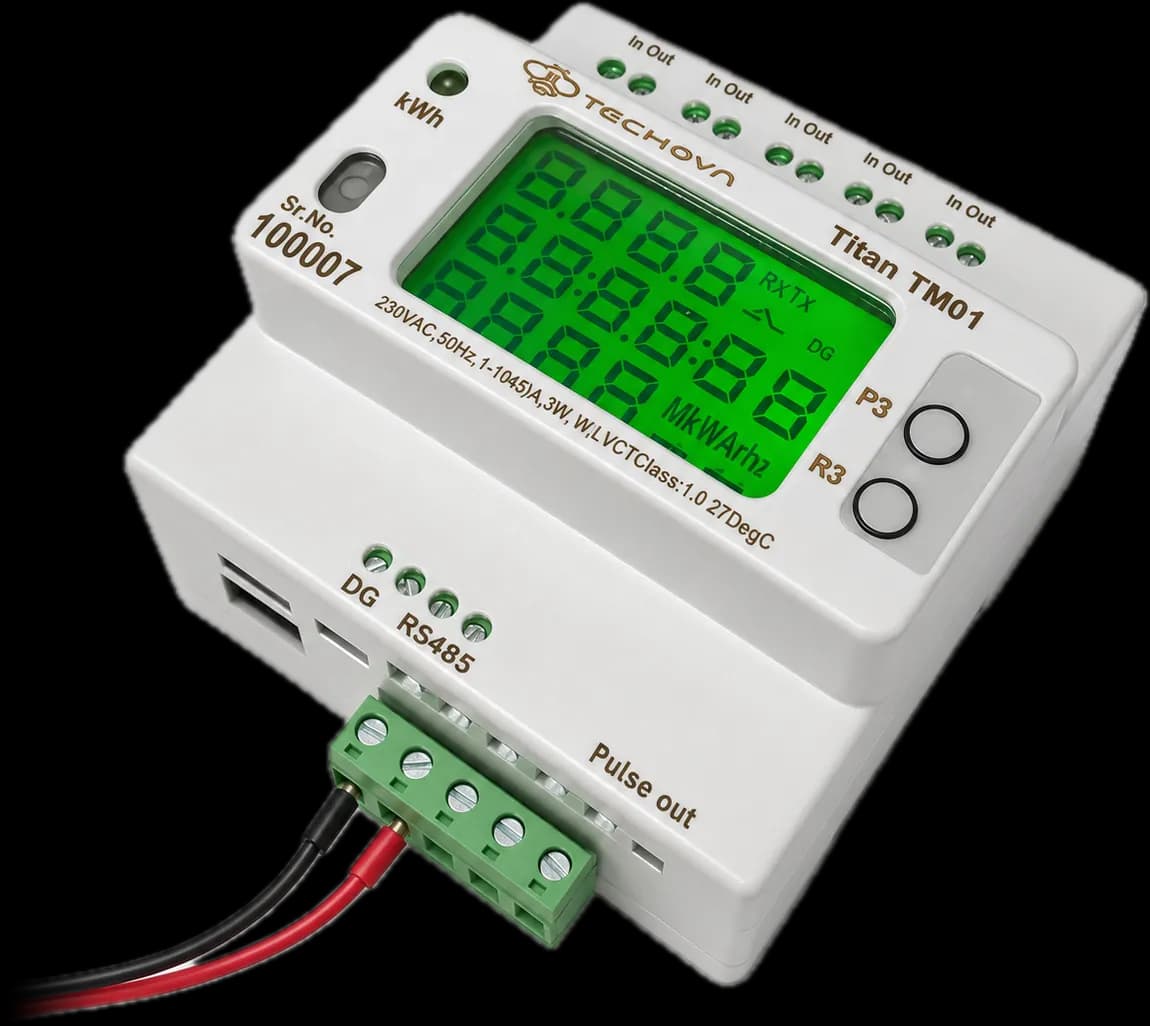
An IoT pump controller that replaces the pump control panel — multi-signal dry-run protection, single-phasing prevention, overload trip, pump wear detection and energy monitoring. Built on the Titan metering engine plus two pressure sensors.
Trusted by energy & industrial leaders






At a glance
- What it is
- A DIN-rail IoT pump controller that replaces the protection, timer, pressure switch and metering inside a pump control panel — and adds pump health and remote control.
- Best for
- Water supply & booster sets, borewell/submersible pumps, HVAC & cooling-tower pumps, fire/jockey pumps, irrigation and process pumps — single or three phase.
- How
- Reuses the Titan Class 0.5S electrical metering and adds two pressure sensors (suction + discharge) for hydraulic protection and wear detection.
- Connectivity
- WiFi, Ethernet, RS485 (Modbus RTU/TCP), Titan App and cloud dashboard with alerts and remote start/stop. OTA firmware.
A Pump Control Panel Protects the Motor — But Tells You Nothing
A conventional pump control panel is a box of single-purpose parts: a single-phasing preventer, an overload relay, a dry-run relay, a timer, a mechanical pressure switch. Each does one job, none of them talk to each other, and none of them tell you anything. When a pump burns out, runs dry, or slowly loses efficiency, the first you hear of it is when the water stops.
The Titan Pump Controller collapses all of that into one intelligent device. The same metering that protects the motor also watches the pump's health, tracks its energy, and puts start/stop and alerts on your phone — because it already knows the electrical and the hydraulic side of every cycle.
Two Sensors On Top of a Titan Meter
The controller already measures all three phases — voltage, current, power, energy. Add a pressure sensor before and after the pump and it can see the whole picture: what the motor is doing, and what the water is doing.
Titan Metering
Per-phase V, I, kW, PF and kWh at Class 0.5S accuracy. This is the same measurement engine as the Titan energy meter — it powers every electrical protection and all the energy analytics, with no extra sensors.
2 Pressure Sensors
One on the suction side, one on the discharge side. Suction pressure catches dry-run and cavitation; discharge pressure drives start/stop; the difference between them is the head the pump is actually developing — the key to wear detection.
Contactor Command
A control relay output drives the existing pump contactor / DOL or star-delta starter. The controller decides when to start, stop, or lock out — locally, on a schedule, on pressure, or from your phone.
Motor Protection — From the Metering, Not Add-On Relays
Because it measures every phase continuously, the electrical protections come for free — no separate single-phasing preventer, overload relay, or phase-sequence relay to wire and maintain.
Single-Phasing Prevention
Won't start a 3-phase pump if a phase is missing, low, or out of sequence. Continuous per-phase voltage and current monitoring replaces the single-phasing preventer relay — protecting the motor from the most common burnout cause.
Voltage & Current Unbalance
Trips on phase unbalance, over/under-voltage, over/under-frequency and phase reversal before the winding overheats — with configurable thresholds and time delays.
Overload & Locked-Rotor
Detects over-current from a jammed impeller, clogged suction, or seized bearing, and catches locked-rotor stall from the start-up in-rush signature. No separate overload relay needed.
Auto-Restart with Lockout
After a transient fault clears — a phase returns or the tank refills — the controller restarts automatically, with a retry limit and cooldown so it never hammers a genuinely faulty motor.
Dry-Run Protection That Trips the Pump — Without Nuisance-Tripping
Dry running is what kills pumps — a submersible or booster pump running with no water overheats its seals and bearings within minutes. The problem with cheap dry-run protection is that it relies on a single signal — a current relay or a pressure switch — so it either misses real dry-run events or trips constantly on normal pressure swings.
The Titan Pump Controller uses three independent signals and only trips when they agree:
- →Motor under-power — a pump moving no water draws far less current than one under load.
- →Low suction pressure — the source tank, sump, or well has run empty, or the foot valve has failed.
- →Loss of differential head — discharge pressure no longer rises above suction, so the pump isn't actually pumping.
When the signals cross-confirm, the pump stops and locks out; after a configurable cooldown it makes a timed recovery attempt, so a tank that simply ran low refills and the pump resumes on its own — without a site visit.
Catch a Failing Pump Before It Fails
The combination of accurate power measurement and differential pressure is what a pump control panel has never had — and it's exactly what you need to see wear coming.
Baseline Power Learning
The controller learns each pump's normal power draw at a given head, then flags when consumption creeps above baseline — the early signature of bearing wear, impeller wear, bushing drag, or a clogging strainer.
Efficiency & Curve Deviation
By trending power against the differential head (discharge minus suction pressure), it spots when a pump drifts off its curve — losing efficiency long before it fails outright.
Dead-Head & Leak Detection
High discharge pressure with no flow flags a closed valve or dead-head; a sudden discharge-pressure collapse under load flags a burst pipe or major leak downstream.
Cavitation & Short-Cycling
Low suction pressure warns of cavitation and low-NPSH risk; rapid on/off cycling is detected and logged — usually a waterlogged bladder tank or a setpoint band that's too tight.
Automatic Control & Remote Operation
Run the pump on pressure, on a schedule, or from your phone — and let a twin-pump set share the load automatically.
Pressure-Based Start/Stop
Maintains constant discharge pressure using a setpoint and deadband on the discharge sensor — replacing the mechanical pressure switch with a configurable, driftless digital one.
Remote Start / Stop
Start or stop the pump from the Titan App or cloud dashboard, from anywhere. See live voltage, current, power and pressure without opening the panel.
Scheduling & Modes
Time-of-day operation, manual/auto modes, and a local override. Duty–standby (lead-lag) rotation across two pumps keeps wear even on twin-pump sets.
Level & Tank Control
An optional level input (float or 4–20 mA) adds tank-fill and empty-cutoff logic on top of pressure control for overhead-tank and sump applications.
Technical Specifications
Electrical metering, hydraulic sensing, control, and connectivity — in one compact DIN-rail device.
Electrical Metering & Protection
| Parameter | Specification |
|---|---|
| Metering Accuracy | Class 0.5S active (IEC 62053-22) — same engine as the Titan meter |
| Phases | Single-phase and three-phase (3-phase 4-wire / 3-wire) |
| Voltage | 57.7 V to 277 V per phase — covers 220/230/240 V and 400/415/480 V systems |
| Current | Direct up to 100 A, or CT-operated with CT primary 10 A – 1000 A |
| Measured | Per-phase V, I, kW, PF, frequency, kWh — plus running hours and start counts |
Hydraulic Sensing
| Parameter | Specification |
|---|---|
| Pressure Inputs | 2 × pressure sensors — suction (before pump) and discharge (after pump) |
| Signal Type | 4–20 mA / ratiometric — sensor range selected to suit the application |
| Derived | Differential head, dead-head detection, cavitation / low-suction warning, leak detection |
| Level Input | Optional float or 4–20 mA level sensor (3rd input) for tank/sump control |
Control
| Parameter | Specification |
|---|---|
| Pump Switching | Control relay output drives the pump contactor / DOL / star-delta starter |
| Protection | Single-phasing, unbalance, over/under-voltage, over-current, locked-rotor, dry-run |
| Dry-Run Logic | Multi-signal — under-power + low suction pressure + loss of differential head |
| Auto-Restart | Configurable retry count, delay and lockout after repeated faults |
Connectivity
| Parameter | Specification |
|---|---|
| WiFi | Built-in 2.4 GHz (802.11 b/g/n) |
| Ethernet | Built-in 10/100 port — Modbus TCP, no serial gateway |
| RS485 | 2-wire bus — Modbus RTU to a BMS / SCADA / PLC |
| MQTT | Publishes to any broker (TLS-secured) over WiFi / Ethernet — stream pump data to your own cloud or EMS, alongside Modbus |
| Cloud & App | Live monitoring, alerts and remote start/stop via the Titan App and Energy Intelligence Platform |
| 4G (remote sites) | For pumps with no WiFi or wired network — borewells, lift-irrigation and rural pumping stations — the Titan Pump RMS provides the same metering and protection over 4G. See the Remote Pump Monitoring System |
| Firmware | Over-the-air (OTA) updates |
In development
The Titan Pump Controller is being introduced on the proven Titan metering platform. Talk to our engineering team about pilot units, pump ratings, pressure-sensor selection and panel integration for your application.
Controller vs Pump Panel vs Dry-Run Relay
A conventional panel bolts single-purpose relays together. A basic dry-run relay does one thing. The Titan Pump Controller does all of it — and adds the intelligence neither has.
| Capability | Titan Pump Controller | Conventional Pump Panel | Basic Dry-Run Relay |
|---|---|---|---|
| Single-phasing prevention | Yes — built in | Add-on relay | No |
| Dry-run protection | Multi-signal (power + pressure) | Single-method add-on | Single-method only |
| False-trip resistance | High — signals cross-confirm | Low–Medium | Low |
| Pump wear / health detection | Yes — baseline + curve | No | No |
| Energy monitoring (kWh, cost) | Yes — Class 0.5S | Ammeter only, if any | No |
| Remote start / stop | Yes — app & cloud | No | No |
| Alerts & event log | Yes — app / email | No | No |
| BMS / SCADA integration | Modbus RTU / TCP | Hard-wired only | No |
| Pressure-based control | Digital setpoint + deadband | Mechanical pressure switch | No |
Controller or RMS — which one do you need?
Titan Pump Controller (this page) decides for itself when to run the pump. Choose it when you want automatic operation on a pressure setpoint or tank level, with lead-lag rotation across a twin-pump set, replacing the relays inside the panel.
Titan Pump RMS watches the pump, and commands it when you ask. Choose it when the starter panel already works and must not be re-engineered, when the site is remote and needs 4G rather than WiFi, and when the requirement is visibility across many unmanned sites — tubewells, lift irrigation, village and municipal pumping stations. Both share the same metering engine and the same dashboard.
Automatic Pump Controller, Energy Monitor and Panel Replacement — In One
Different teams ask for different things. A plant electrician wants an automatic pump controller with proper single-phasing prevention and overload protection. A facilities manager wants pump dry-run protection that won't keep tripping, and pump remote start so nobody has to drive to site to reset a tripped pump. An energy manager wants pump energy monitoring — to know what each pump costs and when one starts drawing more than it should.
The Titan Pump Controller is all of those at once. It is an IoT pump control panel replacement that keeps the contactor and starter you already have, swaps the box of single-purpose relays for one intelligent device, and connects the pump to the cloud — with per-pump energy, wear alerts, event logs and remote control on the Energy Intelligence Platform.
It also fits straight into a building's wider energy picture — because it's built on the same Titan family used for sub-metering and condition monitoring across the rest of the plant.
Built on the Titan Family
The same Class 0.5S accuracy, triple connectivity, and compact DIN-rail form factor as the rest of the Titan range.
| Product | Description | Status |
|---|---|---|
| TITAN | Core smart energy meter. WiFi + Ethernet + RS485 | Active |
| TITAN AUDIT | Rapid deployment logger. Split-core CT, plug & play | Active |
| TITAN EV | EV charge controller. OCPP 2.0.1, IEC 61851 | Active |
| TITAN PQ | Power quality meter. Harmonics, sags, swells, flicker, transients | Coming Soon |
| TITAN ASSET | Condition monitoring. Energy + vibration + temperature | Coming Soon |
| TITAN PLUS BTU | Chiller efficiency meter. kW/TR + BTU on a single device | Coming Soon |
| TITAN BTU | BTU meter. Chilled water, hot water, district cooling | Coming Soon |
| TITAN COMPLIANCE | Fire pump monitoring. NFPA 25 + IS 15301 compliance | Coming Soon |
| TITAN PUMPYou are here | Pump controller. Dry-run protection + energy monitoring + remote start | Coming Soon |
| TITAN PUMP RMS | Remote pump monitoring. 4G, run hours + dry run + fault alerts | Coming Soon |
| TITAN BLOWER | Blower controller. Filter-clog + over-pressure protection + energy monitoring | Coming Soon |
Frequently Asked Questions
Common questions about dry-run protection, single-phasing prevention, energy monitoring, and replacing a pump control panel.
Supply and installation
Need it fitted rather than shipped? The Titan Pump Controller is available with site survey, installation, commissioning and annual maintenance through Trading Engineers, our supply and service partner within the OVN Engineers group.
Stop guessing about your pumps
Talk to our engineering team about a Titan Pump Controller pilot — dry-run protection, energy monitoring and remote control on your pumps.