
Smart Blower Controller
Protect the Blower. Watch the Energy. Control It From Anywhere.
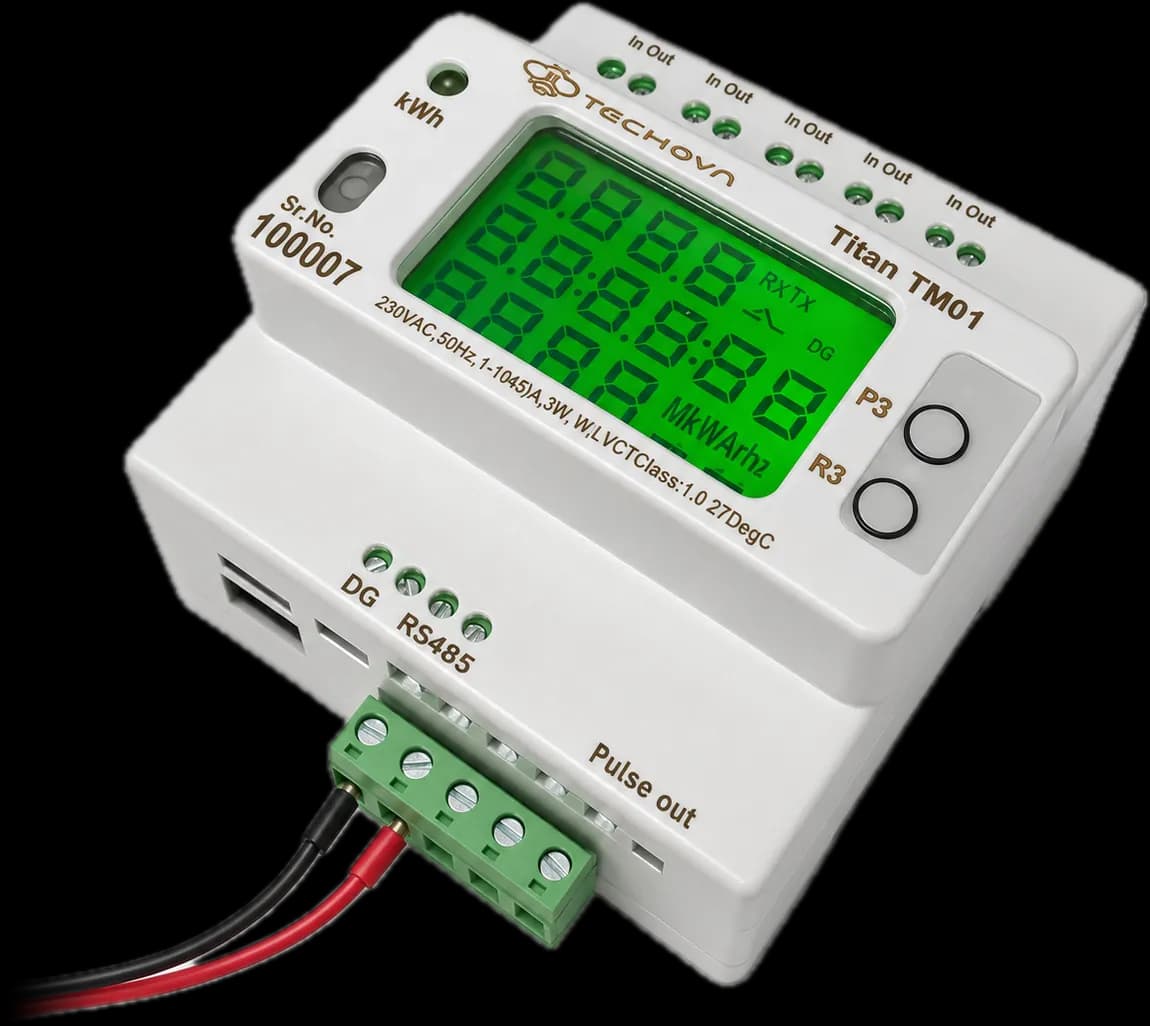
An IoT blower controller that replaces the blower control panel — single-phasing prevention, overload and over-pressure trip, clogged-filter and belt-slip detection, wear tracking and energy monitoring. Built on the Titan metering engine plus two pressure sensors.
Trusted by energy & industrial leaders






At a glance
- What it is
- A DIN-rail IoT blower controller that replaces the protection, timer and metering inside a blower control panel — and adds filter-clog, belt-slip and over-pressure detection with remote control.
- Best for
- STP/ETP aeration blowers, pneumatic conveying, dust collection, combustion/boiler air, biogas — Roots, centrifugal, side-channel and regenerative, single or three phase.
- How
- Reuses the Titan Class 0.5S electrical metering and adds two pressure sensors (inlet + discharge) for airflow protection and wear detection.
- Connectivity
- WiFi, Ethernet, RS485 (Modbus RTU/TCP), Titan App and cloud dashboard with alerts, lead-lag rotation and remote start/stop. OTA firmware.
The Biggest Energy Load in the Plant — Running Blind
In a sewage or effluent treatment plant, the aeration blowers are usually the single largest electricity consumer — and they run around the clock. Yet most run off a conventional blower panel: a single-phasing preventer, an overload relay, a starter. None of them tell you the filter is loading, the belt is slipping, the line is choking, or that the blower is quietly drawing more power every month.
The Titan Blower Controller collapses that box of relays into one intelligent device — because the same metering that protects the motor also watches the airflow, tracks the energy, and puts start/stop, lead-lag and alerts on your phone.
Two Sensors On Top of a Titan Meter
The controller already measures all three phases — voltage, current, power, energy. Add a pressure sensor before and after the blower and it can see the whole picture: what the motor is doing, and what the air is doing.
Titan Metering
Per-phase V, I, kW, PF and kWh at Class 0.5S accuracy — the same measurement engine as the Titan energy meter. It powers every electrical protection and all the energy analytics, with no extra sensors.
2 Pressure Sensors
One on the inlet, one on the discharge. Inlet pressure drop reveals a clogging filter; discharge pressure drives control and over-pressure trip; the two together tell you whether the blower is actually moving air — the key to belt-slip and wear detection.
Contactor Command
A control relay output drives the existing blower contactor / DOL or star-delta starter. The controller decides when to start, stop, rotate or lock out — locally, on a schedule, on pressure, or from your phone.
Motor & Machine Protection — From the Metering, Not Add-On Relays
Because it measures every phase continuously and watches discharge pressure, the protections come built in — no separate single-phasing preventer, overload relay, or over-pressure switch to wire and maintain.
Single-Phasing Prevention
Won't start a 3-phase blower if a phase is missing, low, or out of sequence. Continuous per-phase voltage and current monitoring replaces the single-phasing preventer relay — the most common cause of blower motor burnout.
Overload & Locked-Rotor
Detects over-current from a seized bearing, jammed lobe, or over-pressurised system, and catches locked-rotor stall from the start-up in-rush signature. No separate overload relay to size and wire.
Over-Pressure Trip
Positive-displacement and Roots blowers dead-head dangerously when a downstream line chokes. The discharge pressure sensor trips the blower before the relief valve blows or the motor overloads — protecting the blower and the belt.
Auto-Restart with Lockout
After a transient fault clears — a phase returns or pressure normalises — the controller restarts automatically, with a retry limit and cooldown so it never hammers a genuinely faulty machine.
Clogged Filters, Choked Lines and Slipping Belts — Caught Early
A blower rarely fails all at once. It loads up a filter, chokes a line, slips a belt, or over-pressurises — and a conventional panel sees none of it until the overload finally trips or the relief valve lifts. The Titan Blower Controller reads the two things that matter together — power and pressure — and tells them apart:
- →Clogging filter — a slowly rising pressure drop across the intake, trended over days, flags the filter for cleaning before it starves the blower and wastes energy.
- →Choked line / over-pressure — high discharge pressure with rising power means a blocked diffuser or closed valve; the controller trips before the relief valve or motor.
- →Belt slip / no air — power drawn but no rise in discharge pressure means a slipping or broken belt, or an uncoupled blower spinning to no effect.
Each condition raises a distinct alert with an event-log entry — so the operator knows what to fix, not just that something tripped.
Catch a Failing Blower Before It Fails
Accurate power measurement combined with discharge pressure is what a blower panel has never had — and it's exactly what you need to see bearing wear, lobe drift and filter loading coming.
Baseline Power Learning
The controller learns each blower's normal power draw at a given discharge pressure, then flags when consumption creeps above baseline — the early signature of bearing wear, lobe-clearance drift, or a loading filter.
Clogged-Filter Trending
A blocked intake filter starves the blower and wastes energy. By trending the pressure drop across the inlet over time, the controller tells you when the filter actually needs cleaning — not on a fixed calendar.
Belt-Slip & No-Load Detection
When the motor draws power but discharge pressure doesn't rise, the belt is slipping or broken, or the blower is uncoupled. The controller catches it immediately instead of running a motor that moves no air.
Efficiency & Choke Detection
Trending power against discharge pressure spots a blower drifting off its curve; high discharge pressure with rising power flags a choked diffuser or blocked line before it trips.
Demand-Based Control & Lead-Lag Rotation
Run the blower on pressure or dissolved-oxygen demand, rotate a bank of blowers automatically, and control the lot from your phone.
Pressure-Based Control
Holds a target header or aeration back-pressure using a setpoint and deadband on the discharge sensor — so the blower matches demand instead of running flat-out against a throttle.
Lead-Lag (Duty–Standby)
Rotates duty and standby across a bank of blowers — the norm in STP/ETP aeration — to equalise run-hours, auto-start the standby on a fault, and stop short-cycling the whole bank.
Remote Start / Stop
Start or stop the blower from the Titan App or cloud dashboard, from anywhere. See live voltage, current, power and pressure without opening the panel or standing next to a screaming machine.
Scheduling & Modes
Time-of-day operation, manual/auto modes, and a local override — with an optional dissolved-oxygen (DO) or 4–20 mA process input to drive demand-based aeration.
Technical Specifications
Electrical metering, airflow sensing, control, and connectivity — in one compact DIN-rail device.
Electrical Metering & Protection
| Parameter | Specification |
|---|---|
| Metering Accuracy | Class 0.5S active (IEC 62053-22) — same engine as the Titan meter |
| Phases | Single-phase and three-phase (3-phase 4-wire / 3-wire) |
| Voltage | 57.7 V to 277 V per phase — covers 220/230/240 V and 400/415/480 V systems |
| Current | Direct up to 100 A, or CT-operated with CT primary 10 A – 1000 A |
| Measured | Per-phase V, I, kW, PF, frequency, kWh — plus running hours and start counts |
Airflow Sensing
| Parameter | Specification |
|---|---|
| Pressure Inputs | 2 × pressure sensors — inlet/suction (before blower) and discharge (after blower) |
| Signal Type | 4–20 mA / ratiometric — sensor range selected to suit the application |
| Derived | Differential pressure, clogged-filter trend, over-pressure / choke detection, belt-slip detection |
| Process Input | Optional dissolved-oxygen (DO) or 4–20 mA input (3rd input) for demand-based aeration control |
Control
| Parameter | Specification |
|---|---|
| Blower Switching | Control relay output drives the blower contactor / DOL / star-delta starter |
| Protection | Single-phasing, unbalance, over/under-voltage, over-current, locked-rotor, over-pressure |
| Fault Logic | Multi-signal — under-power + no pressure rise (belt slip) vs high pressure + rising power (choke) |
| Lead-Lag | Duty–standby rotation across a blower bank with auto-changeover on fault |
Connectivity
| Parameter | Specification |
|---|---|
| WiFi | Built-in 2.4 GHz (802.11 b/g/n) |
| Ethernet | Built-in 10/100 port — Modbus TCP, no serial gateway |
| RS485 | 2-wire bus — Modbus RTU to a BMS / SCADA / PLC |
| MQTT | Publishes to any broker (TLS-secured) over WiFi / Ethernet — stream blower data to your own cloud or EMS, alongside Modbus |
| Cloud & App | Live monitoring, alerts and remote start/stop via the Titan App and Energy Intelligence Platform |
| Firmware | Over-the-air (OTA) updates |
In development
The Titan Blower Controller is being introduced on the proven Titan metering platform. Talk to our engineering team about pilot units, blower ratings, pressure-sensor selection and panel integration for your application.
Controller vs Blower Panel vs Overload Relay
A conventional panel bolts single-purpose relays together. A basic overload relay does one thing. The Titan Blower Controller does all of it — and adds the intelligence neither has.
| Capability | Titan Blower Controller | Conventional Blower Panel | Basic Overload Relay |
|---|---|---|---|
| Single-phasing prevention | Yes — built in | Add-on relay | No |
| Over-pressure protection | Yes — from discharge sensor | Relief valve only | No |
| Clogged-filter detection | Yes — differential trend | No | No |
| Belt-slip / no-air detection | Yes — power vs pressure | No | No |
| Blower wear / health | Yes — baseline + curve | No | No |
| Energy monitoring (kWh, cost) | Yes — Class 0.5S | Ammeter only, if any | No |
| Lead-lag rotation | Yes — auto changeover | Separate PLC/panel | No |
| Remote start / stop | Yes — app & cloud | No | No |
| BMS / SCADA integration | Modbus RTU / TCP | Hard-wired only | No |
Air Blower Control Panel, Energy Monitor and Aeration Controller — In One
Different teams ask for different things. A plant electrician wants an air blower control panel with proper single-phasing prevention and overload protection. A plant operator wants clogged-filter and over-pressure protection and lead-lag rotation across the aeration blower bank. An energy manager wants blower energy monitoring — because in an STP or ETP the aeration blowers are the biggest power bill in the plant.
The Titan Blower Controller is all of those at once. It is an IoT blower control panel replacement that keeps the contactor and starter you already have, swaps the box of single-purpose relays for one intelligent device, and connects the blower to the cloud — with per-blower energy, wear alerts, event logs and remote control on the Energy Intelligence Platform.
It shares the exact platform as the Titan Pump Controller — so a treatment plant can run its pumps and blowers on one system, with condition monitoring across all of its rotating equipment.
Built on the Titan Family
The same Class 0.5S accuracy, triple connectivity, and compact DIN-rail form factor as the rest of the Titan range.
| Product | Description | Status |
|---|---|---|
| TITAN | Core smart energy meter. WiFi + Ethernet + RS485 | Active |
| TITAN AUDIT | Rapid deployment logger. Split-core CT, plug & play | Active |
| TITAN EV | EV charge controller. OCPP 2.0.1, IEC 61851 | Active |
| TITAN PQ | Power quality meter. Harmonics, sags, swells, flicker, transients | Coming Soon |
| TITAN ASSET | Condition monitoring. Energy + vibration + temperature | Coming Soon |
| TITAN PLUS BTU | Chiller efficiency meter. kW/TR + BTU on a single device | Coming Soon |
| TITAN BTU | BTU meter. Chilled water, hot water, district cooling | Coming Soon |
| TITAN COMPLIANCE | Fire pump monitoring. NFPA 25 + IS 15301 compliance | Coming Soon |
| TITAN PUMP | Pump controller. Dry-run protection + energy monitoring + remote start | Coming Soon |
| TITAN PUMP RMS | Remote pump monitoring. 4G, run hours + dry run + fault alerts | Coming Soon |
| TITAN BLOWERYou are here | Blower controller. Filter-clog + over-pressure protection + energy monitoring | Coming Soon |
Frequently Asked Questions
Common questions about blower protection, clogged-filter detection, aeration control, energy monitoring, and replacing a blower control panel.
Stop guessing about your blowers
Talk to our engineering team about a Titan Blower Controller pilot — filter-clog and over-pressure protection, energy monitoring and remote control on your aeration blowers.