
Solution
AI Condition Monitoring — Catch Failures Before They Happen
Energy + Vibration + Temperature. One Device. One Dashboard.
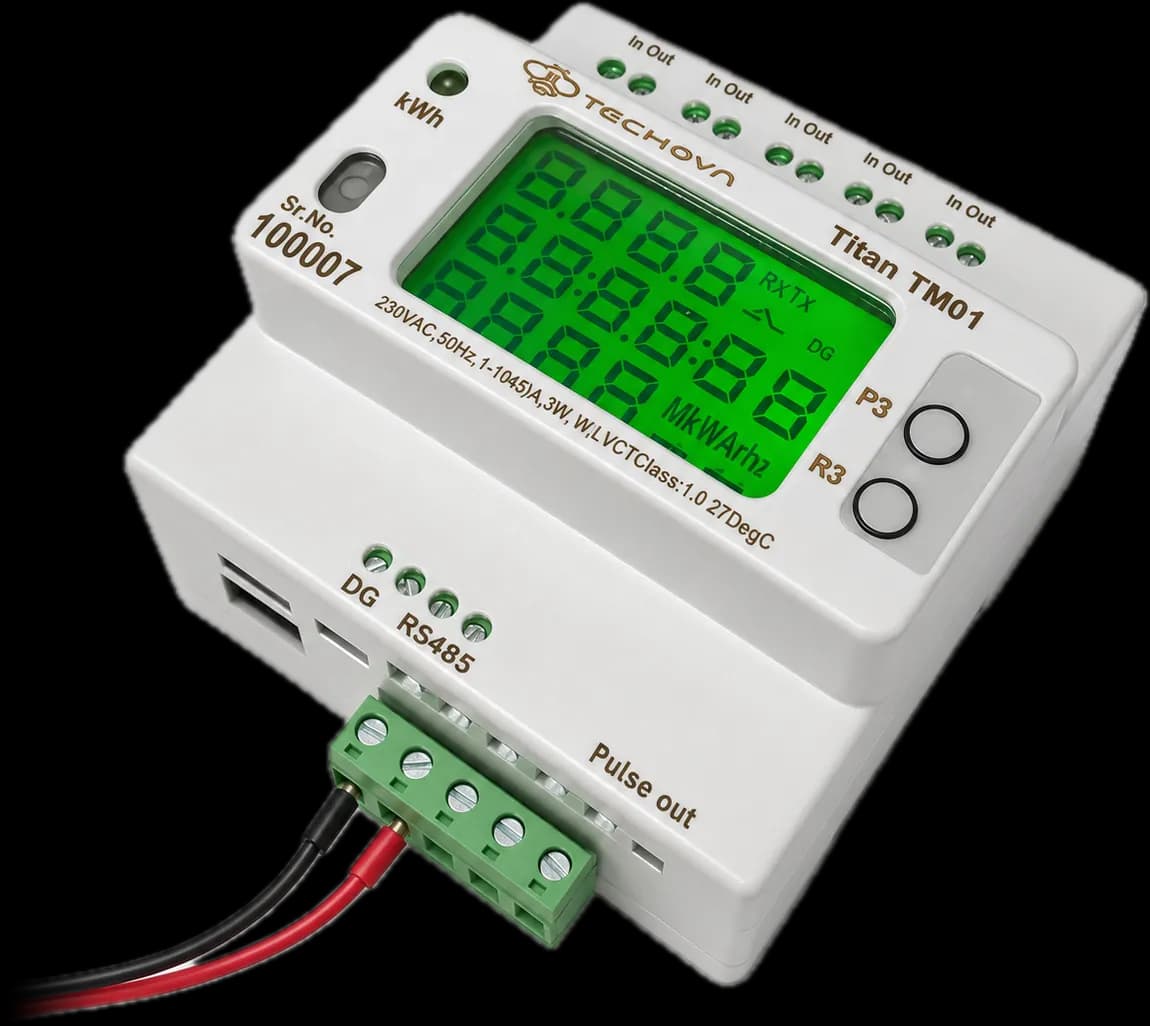
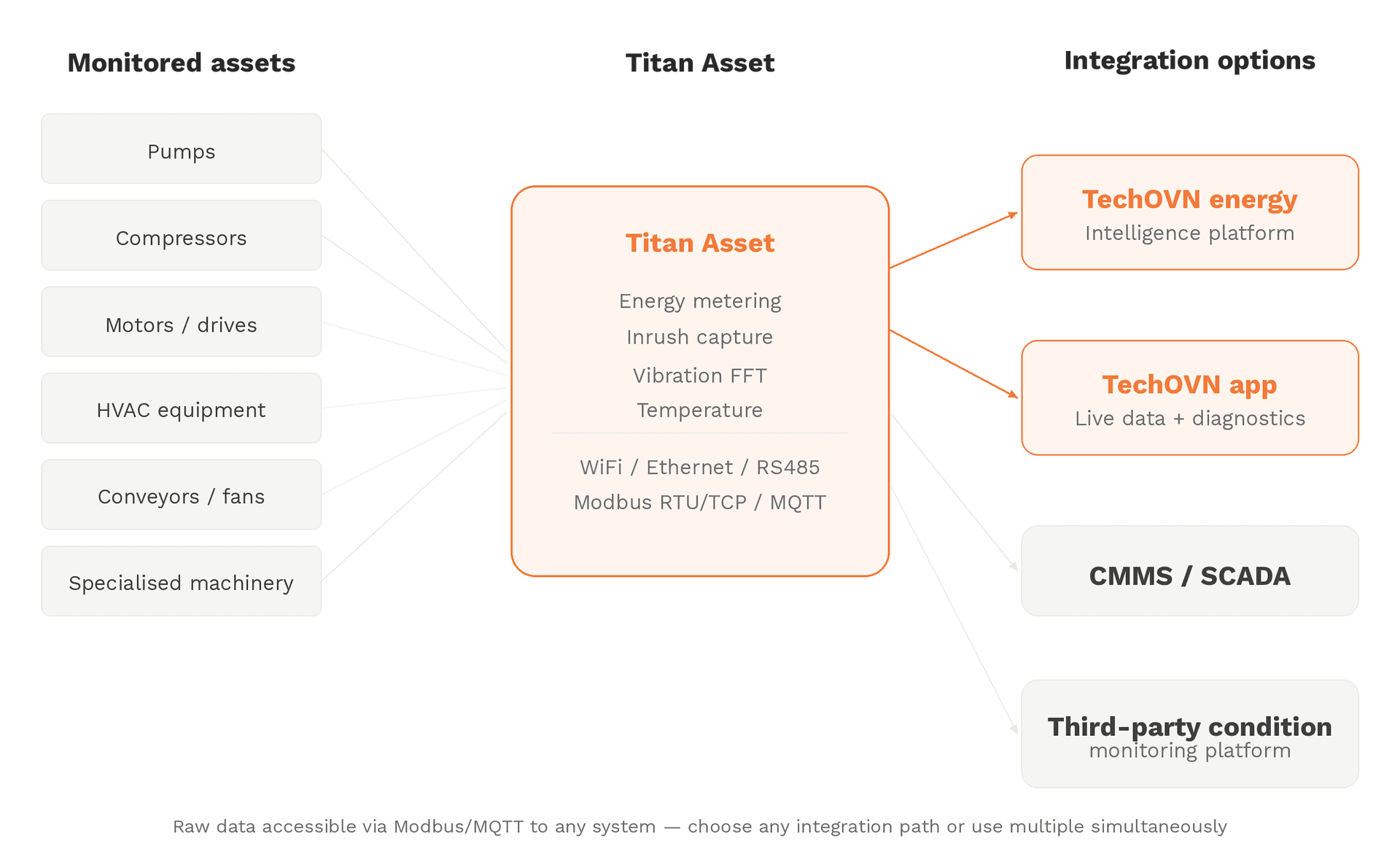
AI condition monitoring is the use of energy, vibration, and temperature data — analysed by anomaly-detection algorithms — to predict equipment failures before they happen. It is the sensor layer behind predictive maintenance IoT deployments. Tech OVN's Titan Asset combines all three sensors in a single DIN rail device and feeds the platform's baseline-learning engine for motors, pumps, compressors, and other critical assets.
The Maintenance Problem
Most facilities maintain critical equipment on a fixed schedule — quarterly inspections, annual rebuilds, time-based replacements. The schedule is conservative because the cost of unplanned failure is high: a single compressor failure can shut down a production line for days. So facilities over-maintain to be safe.
The problem is two-fold. Over-maintenance is expensive — you're replacing parts and paying labour on equipment that doesn't need it yet. And it's not actually safe: equipment still fails between scheduled inspections, because random failures don't read calendars.
Predictive maintenance flips the model. Instead of a calendar, you watch the equipment's actual behaviour — power signature, vibration spectrum, bearing temperature — and intervene only when the data says something is wrong.
The barrier has been hardware cost: traditional vibration probes, thermal cameras, and power quality analysers each cost thousands per asset. Titan Asset combines all three sensors in one DIN rail device — at a price that makes asset-level monitoring practical for the first time.
What Titan Asset Measures
Three sensor channels on the same DIN rail device.
Electrical Signature
Same Class 0.5S metering engine as the Titan base meter: V, I, P, PF, f, harmonics. Motor current signature analysis (MCSA) detects rotor bar issues, eccentricity, and bearing degradation from the electrical side alone.
Vibration (MEMS FFT)
On-device MEMS accelerometer with FFT spectrum analysis. Detects unbalance, misalignment, looseness, bearing faults (BPFO/BPFI/BSF/FTF), gear mesh issues, and resonance — all from vibration.
Temperature
Bearing temperature, winding temperature, ambient — feeding into thermal degradation models. Combined with vibration, temperature trends are a leading indicator of bearing failure.
How AI Condition Monitoring Works
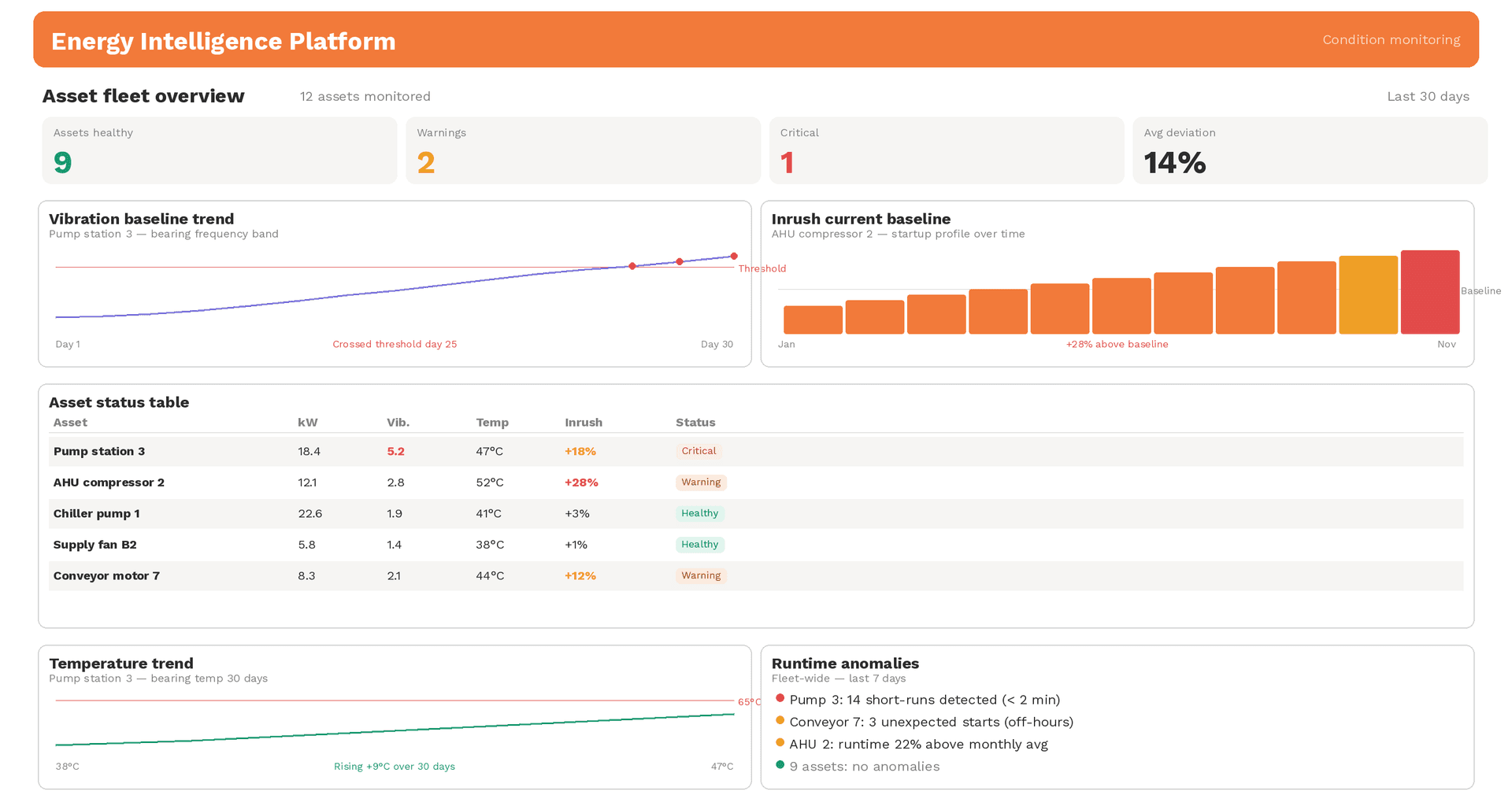
The meter captures the data. The Energy Intelligence Platform turns it into decisions.
- 1
Baseline Learning
For the first weeks after installation, the platform records normal operation across all three sensor channels. It learns what 'healthy' looks like for this specific motor, this specific pump, in this specific facility — not a generic textbook baseline.
- 2
Anomaly Scoring
After the baseline is established, the platform scores every reading against the learned normal. Small deviations trigger watch-list status; large deviations trigger alerts.
- 3
Predictive Alerts
Alerts are tied to specific failure modes — bearing wear, rotor imbalance, increased winding temperature, power factor drift. Maintenance teams know what to inspect before they get there.
- 4
Fleet-Level Trending
Across multiple assets, the platform identifies fleet-wide patterns: which model of pump always fails the same way, which compressor brand drifts faster, which vendor's bearings last longer.
Where It Fits
Five common scenarios from individual motors to OEM equipment packages.
Industrial Motors
Bearing failure detection. Eccentricity. Rotor bar issues. Insulation degradation tracked through power factor and harmonic trends.
Pumps & Compressors
Cavitation detection. Impeller wear. Vibration patterns from flow disruption. Combined with energy data: efficiency decline tracked over time.
HVAC Equipment
Chiller compressor monitoring. Cooling tower fan vibration. Pump health for chilled water and condenser water loops.
Manufacturing Lines
Critical line equipment monitored centrally. Predictive alerts before line stops. Maintenance scheduled into planned downtime.
OEM Pump & Compressor Manufacturers
White-label Titan Asset into your equipment for built-in condition monitoring. Differentiate on uptime data, not just hardware specs.
Why Titan Asset
- Three sensors, one device — energy, vibration, temperature on one DIN rail card
- Class 0.5S electrical accuracy — same as the rest of the Titan family
- MEMS FFT on-device — vibration spectrum without a separate analyser
- WiFi or Ethernet to the Energy Intelligence Platform
- Baseline learning + anomaly scoring — AI models on platform-side
- OEM-ready — white-label for pump and compressor manufacturers
Frequently Asked Questions
Seven common questions about AI condition monitoring, baselines, and OEM integration.
Where this fits
Condition monitoring is one half of what circuit-level measurement gives a facility — here is the other half.
Energy efficiency
The same meter read for consumption rather than condition — measurement and verification, penalty exposure and retrofit payback.
Learn More →Facility management
One measurement layer serving both the energy budget and the maintenance budget across a building or a portfolio.
Learn More →Titan Asset
The product behind this page — metering, MEMS vibration FFT and temperature on one DIN rail device.
Learn More →Ready to move from schedule to signal?
Talk to our team about Titan Asset for your motors, pumps, compressors, or OEM equipment line.