
Power Quality Analyzer — Class S, Continuous, Cloud-Connected
Permanent IEC 61000-4-30 Class S power quality monitoring with Class 0.2S revenue-grade energy on the same DIN-rail device. Harmonics to the 63rd, flicker, transients, sag/swell with waveform capture, ITIC/CBEMA classification, and auto-generated EN 50160 + IEEE 519 reports.
Trusted by energy & industrial leaders






Continuous Power Quality — Not Periodic Surveys
Power quality problems are rarely steady-state. Voltage sags happen for cycles. Harmonics shift with load. Transients fire during switching events. Periodic 7-day handheld surveys catch the easy stuff and miss the hard stuff — the intermittent events that actually cause equipment failure, premature transformer ageing, and unexplained downtime.
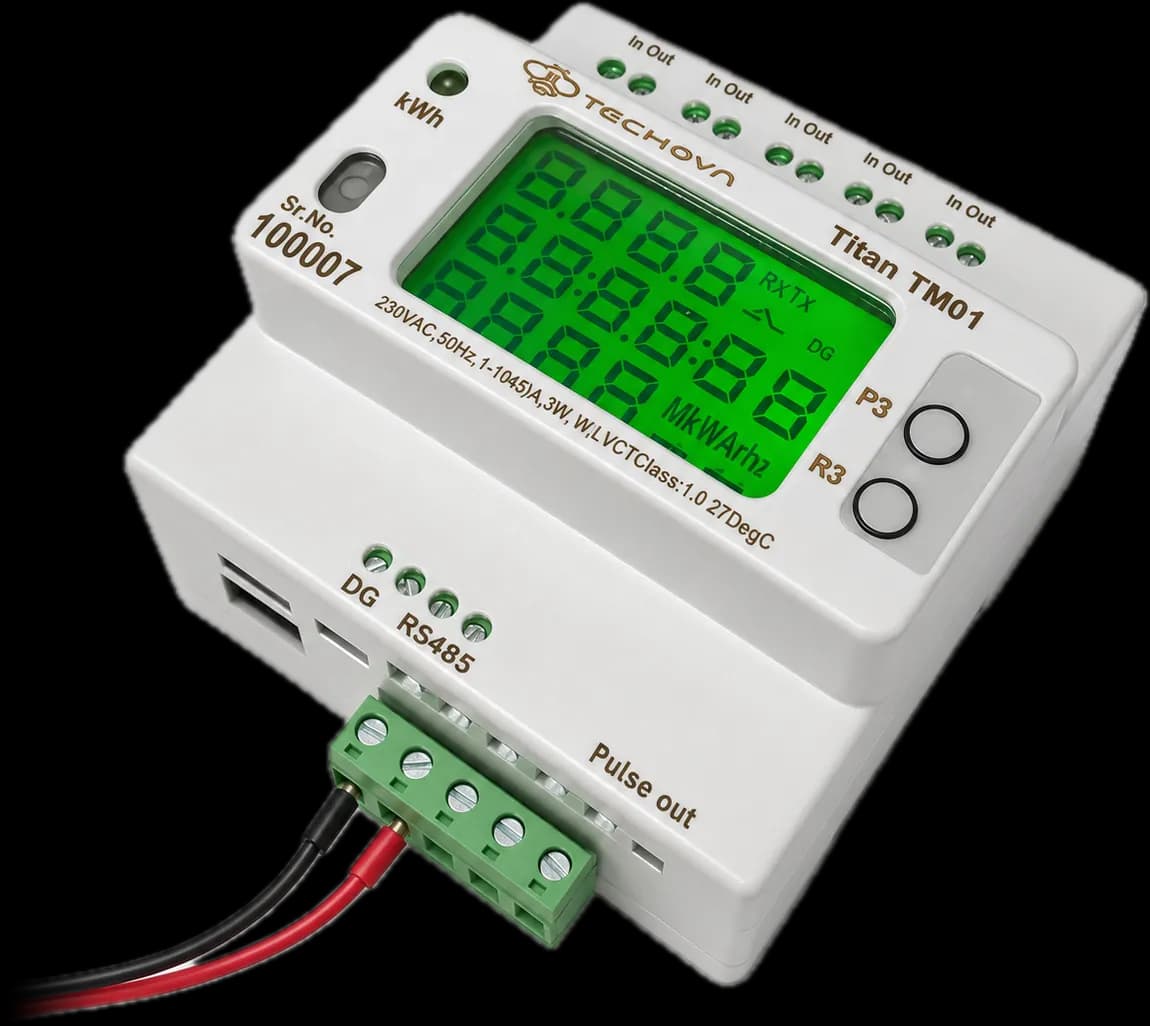
Tech OVN's power quality analyzer is built for permanent, continuous monitoring on incoming feeders, critical loads, and grid interconnection points. IEC 61000-4-30 Class S measurement with revenue-grade Class 0.2S energy on the same device — the standards that satisfy industrial PQ tenders, utility compliance reporting, and CEA grid-connectivity harmonics requirements. Auto-generated EN 50160 and IEEE 519 compliance reports. Manufactured in India and shipped across the Middle East, Southeast Asia, Europe, and Africa.
What the Analyzer Does
Six capabilities that distinguish a real Class S continuous PQ analyzer from a portable survey tool.
IEC 61000-4-30 Class S
Power quality measurement to the standard tender writers cite. 10/12-cycle aggregation, IEEE 1588 time sync, IEC 62586-2 PQI-S third-party validation on the certification roadmap.
Continuous, Permanent Monitoring
Designed for permanent DIN-rail installation — not a portable tool you bring out when there's a problem. Catches transient events, intermittent harmonics, and rare voltage events that handheld surveys miss.
EN 50160 + IEEE 519 Compliance Reports
Auto-generated weekly compliance reports against EN 50160 (European voltage characteristics) and IEEE 519 (harmonic distortion limits). Submit-ready for utility, regulator, or internal QMS.
Harmonics to the 63rd Order
Individual + total harmonic distortion (THD, TDD, TEHD, TOHD) for voltage and current to the 63rd harmonic plus inter-harmonics per IEC 61000-4-7. Critical for VFD-heavy plants, data centres, and industries with sensitive electronics.
Revenue-Grade Energy + PQ in One Device
Class 0.2S active energy (IEC 62053-22) and Class 0.5S reactive energy (IEC 62053-24) on the same device — so a single install delivers both the energy bill audit and the power-quality audit. 4-quadrant kWh/kvarh/kVAh, sliding-window demand, up to 8 TOU/TOD tariffs.
Sag / Swell / Transient Capture
Per-phase 1/2-cycle RMS sag/swell with magnitude + duration + waveform capture. Transient detection above 50 μs with triggered waveform recording. RVC per IEC 61000-4-30 Ed.3. Disturbance direction (upstream vs downstream) for fault attribution.
Where It's Deployed
Wherever continuous PQ visibility supports compliance, uptime, or utility-interface accountability.
Industrial Plants & Manufacturing
Large motor loads, VFDs, welding, induction furnaces — continuous PQ monitoring identifies harmonic distortion driving equipment failure, transformer overheating, and unexplained downtime.
Data Centres & Hyperscale Facilities
PUE depends on clean power; UPS efficiency is sensitive to PQ. Continuous Class S monitoring on incomers, UPS bypass, and critical PDUs catches PQ events before they cascade.
Hospitals & Healthcare
Medical equipment, OT / ICU power, MRI / CT scanner loads — all sensitive to PQ disturbances. Continuous monitoring supports NABH and joint-commission audit readiness.
Utilities & DISCOMs (Customer-Side)
Industrial and commercial customers documenting PQ at the utility interface — for contractual SLAs, indemnity claims, and tariff reclassification disputes.
Renewables & Solar Plants
Inverter-driven generation introduces harmonics; grid weakness causes sags. PQ monitoring at the PCC (point of common coupling) is increasingly required by grid codes.
Commercial Real Estate
Premium-grade office and retail buildings advertising power-quality SLA to tenants. Monitoring on incoming feeders documents performance against the SLA.
PQ Analyzer Specifications
| Parameter | Specification |
|---|---|
| PQ Measurement Class | IEC 61000-4-30 Class S |
| PQ Instrument Performance | IEC 62586-2 PQI-S (certification roadmap) |
| Active Energy Accuracy | Class 0.2S per IEC 62053-22 |
| Reactive Energy Accuracy | Class 0.5S per IEC 62053-24 |
| Compliance Reports | EN 50160 (voltage characteristics), IEEE 519 (harmonic limits) |
| Channels | 3-phase 4-wire (V + I) with direct 4th CT neutral measurement |
| Harmonics (V & I) | Up to 63rd + inter-harmonics per IEC 61000-4-7 |
| Distortion Indices | THD, TDD, TEHD, TOHD; K-factor; crest factor |
| Flicker | Pst (10 min) & Plt (2 hr) per IEC 61000-4-15; ΔV10 (Indian/Japanese grid) |
| Transient Detection | >50 μs with triggered waveform capture |
| Sag / Swell / RVC | 1/2-cycle RMS, magnitude + duration; RVC per IEC 61000-4-30 Ed.3 |
| Disturbance Direction | Upstream vs downstream identification |
| Sampling Rate | 256 samples/cycle (12.8 kHz at 50 Hz) |
| Communication | RS-485 / Modbus RTU + dual Ethernet / Modbus TCP (daisy-chain), Wi-Fi optional |
| Time Sync | PTP (IEEE 1588), NTP, GPS, SNTP |
| Form Factor | DIN rail (compact); 96×96 mm panel option on roadmap |
| Operating Temperature | −25 °C to +70 °C |
| Safety / Marking | CAT III 600 V (CAT IV optional); CE (UL optional) |
| Internal Memory | 2 GB flash |
| Cloud Platform | Tech OVN Energy Intelligence Platform — multi-site, multi-user, mobile |
Why Tech OVN
Four reasons facility teams and PQ consultants standardise on Titan PQ for permanent installations.
Class S — and Affordable
Most IEC 61000-4-30 power quality analyzers in this feature class come from European brands at European prices. Tech OVN delivers Class S measurement plus Class 0.2S energy on hardware manufactured in India — drastically lower TCO without compromise on the standard.
Built for Permanent Installation
Many PQ analyzers are portable handhelds dressed up with a panel mount. Titan PQ was designed from the ground up for continuous unattended monitoring — DIN-rail (96×96 mm panel option on roadmap), robust comms, no moving parts.
Cloud-Native, Not Cloud-Bolted-On
Real-time streaming, cloud-side compliance report generation, multi-site dashboard, and mobile alerts — built into the product, not licensed as a separate module.
From the Energy-Meter Side, Not the Test-Equipment Side
We come from utility-grade energy metering — accuracy, calibration, and long-term drift behaviour are built into the product DNA. Many PQ vendors come from test-equipment heritage where short-term accuracy is fine but long-duration field reliability isn't the focus.
Pair With Energy Monitoring + Audit Equipment
PQ analysis is most valuable when combined with energy monitoring (correlate PQ events with consumption spikes) and portable logging (initial site survey before permanent install). All three run on the same Tech OVN platform.
Frequently Asked Questions
Common questions about Class S, EN 50160 / IEEE 519, harmonics, permanent vs portable, and global supply.
Class S continuous power quality monitoring
Talk to our team about industrial, data centre, healthcare, and utility-interconnect deployments. Cloud platform, multi-site, global supply.