
Solution
Energy and Asset Monitoring for Facility Management
One measurement layer. Two budgets.
Facility teams are asked to cut energy cost and keep plant running, and are usually sold two separate systems to do it. They are the same measurement. A Class 0.5S meter on a chiller feeder tells you what that chiller costs to run and, from the same readings, that its compressor is drifting away from how it behaved at commissioning. Tech OVN builds that one layer — for a single building or a portfolio.
At a glance
- What it is
- Circuit-level Class 0.5S metering that serves energy reporting and equipment condition monitoring from the same data.
- Who it is for
- In-house facility teams, FM service providers, building owners and landlords running one site or a portfolio.
- Integration
- BACnet/IP, BACnet MS/TP, Modbus RTU, Modbus TCP and MQTT — native, no gateway. Feeds an existing BMS, CMMS or EMS; our platform is optional.
- Commercial terms
- No MOQ on catalogue meters — single units ship from stock, so a pilot is one meter. 4 weeks from confirmed PO. Made in India.
- Install disruption
- Split-core CTs allow a baseline assessment with no shutdown. Permanent meters need a planned isolation per circuit.
- Per-site infrastructure
- None. Meters reach the platform over WiFi or Ethernet directly — no energy-server PC, gateway or per-site licence.
Why facility teams pay twice for the same measurement
Energy efficiency and equipment reliability are run as separate programmes. Efficiency sits with the energy or sustainability team and buys metering. Reliability sits with maintenance and buys vibration sensors, thermal surveys or a contractor on a quarterly round. Two budgets, two procurement cycles, two sets of hardware on the same switchboard.
The split is historical, not technical. A motor that is degrading draws more current, holds a different power factor, starts harder and runs longer to do the same work. Every one of those is visible to a meter that is already on the circuit for billing reasons — if anyone is reading it that way.
Measure once. Read it twice. The meter you install to explain the energy bill is also the earliest warning you will get that a chiller compressor, booster pump or AHU fan is on its way out.
One meter, two budgets
What the same Class 0.5S measurement gives each side of the facility brief.
The energy budget
Circuit-level kWh, kVA and power factor on every feeder — chillers, AHUs, pumps, lifts, lighting, tenant supplies. Where consumption actually goes, what the penalty exposure is, and whether last year's retrofit held.
The maintenance budget
The same measurement, read differently. Runtime, duty cycle, inrush profile and current-distortion trends say when a motor is drifting away from how it ran at commissioning — weeks before it fails.
One install, one vendor
Both outcomes come off the same DIN rail device on the same network, commissioned once. No second sensor layer, no second contractor, no second dashboard to reconcile against the first.
Each side has a page of its own: energy efficiency covers the measurement-and-verification side, and AI condition monitoring covers predictive maintenance with vibration and temperature added to the electrical signature.
What gets metered in a building
The systems a facility team is accountable for, and what measurement adds to each.
Chiller plant and HVAC
kW/TR and COP measured rather than estimated, plus compressor and pump condition from the same point. HVAC is usually 40–60% of a commercial building's load, so it is where both budgets concentrate.
Pumps and water systems
Booster sets, sumps, cooling-tower and condenser-water pumps. Dry-run and cavitation signatures show up in the electrical trend long before the pump is audibly failing.
Common-area and tenant supplies
CAM charges that reconcile to measured kWh instead of apportioned estimates, and per-tenant sub-billing that holds up when a tenant disputes it.
Standby power
DG sets and UPS feeders metered continuously, so fuel efficiency and battery-backed load are known numbers rather than assumptions discovered during an outage.
Lifts, lighting and small power
The circuits nobody meters individually, which is exactly why nobody can explain their consumption. One meter per feeder makes the base load legible.
Fire pump compliance
Weekly and monthly NFPA 25 / IS 15301 test runs detected and logged automatically, with an inspector-ready PDF — removing the paper logbook as a compliance risk.
It works with the systems you already run
Facility teams rarely get to start clean. There is a BMS, often a CMMS or CAFM, sometimes a landlord's reporting pack, and a budget that will not stretch to replacing any of them.
Every Titan meter speaks BACnet/IP, BACnet MS/TP, Modbus RTU, Modbus TCP and MQTT natively, with no gateway or protocol converter. The RS485 port carries Modbus RTU or BACnet MS/TP, selected at commissioning. So the BMS keeps its control role and gains a metering-grade measurement layer underneath it, while anomaly alerts can raise work orders in the CMMS you already use.
The Energy Intelligence Platform is available if you want the portfolio view, reporting and anomaly engine without building them — but it is optional, and no data path requires a Tech OVN server. If you want the distinction between these systems in detail, see EMS vs BMS vs SCADA.
What to deploy
Three products cover most facility briefs. All share the same Class 0.5S metering engine, so data is comparable across them.
Titan — permanent circuit metering
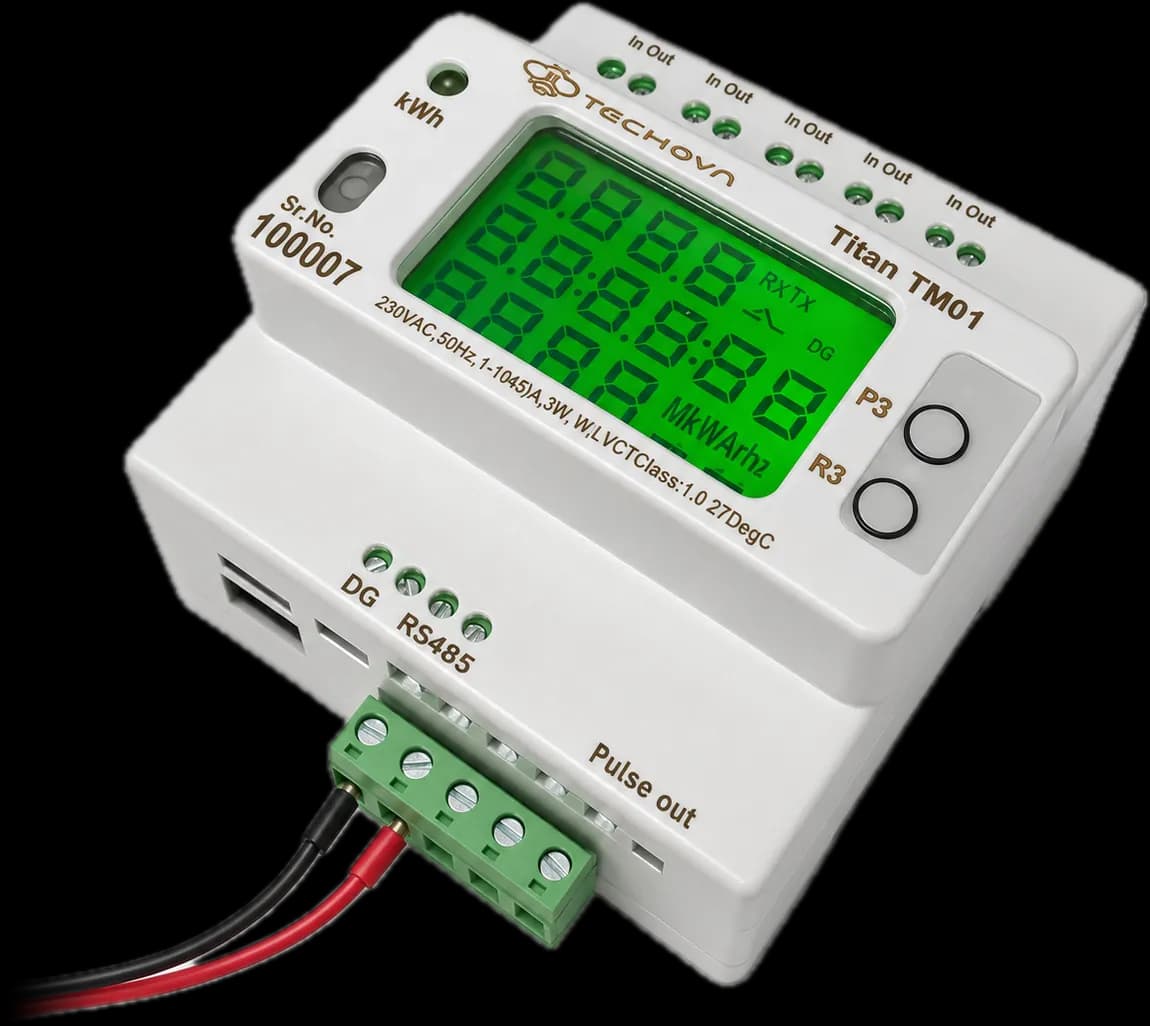
The DIN rail meter that goes on each feeder for continuous energy accountability, tenant billing and runtime trending. Start here.
Learn More →Titan Audit — assessment without shutdown
Split-core CTs for a baseline survey of a running building before you commit to permanent metering, or for short measurement campaigns.
Learn More →Titan Asset — critical rotating plant
Adds MEMS vibration FFT and temperature to the metering engine, for the chillers, pumps and motors whose failure stops the building.
Learn More →Frequently Asked Questions
Seven questions facility managers ask before specifying a measurement layer.
Related
Building energy monitoring
The system-level page for commercial premises — chiller plant, tenant risers and BMS integration over BACnet.
Learn More →Energy efficiency
Measurement and verification — proving a retrofit delivered, and finding the next one.
Learn More →AI condition monitoring
Predictive maintenance with vibration and temperature on top of the electrical signature.
Learn More →Energy management system
The platform layer — portfolio dashboards, ISO 50001 reporting and anomaly detection.
Learn More →Offices
Measurement patterns for corporate offices and multi-tenant floors.
Learn More →Malls and retail
Common-area load, tenant sub-billing and CAM reconciliation.
Learn More →Hotels
Guest-floor HVAC, laundry and kitchen loads, and standby power.
Learn More →One measurement layer for both budgets
Talk to our team about metering a building or a portfolio — including which circuits to meter first.