
Solution
Machine Energy Monitoring System
Energy cost per part, for every machine.
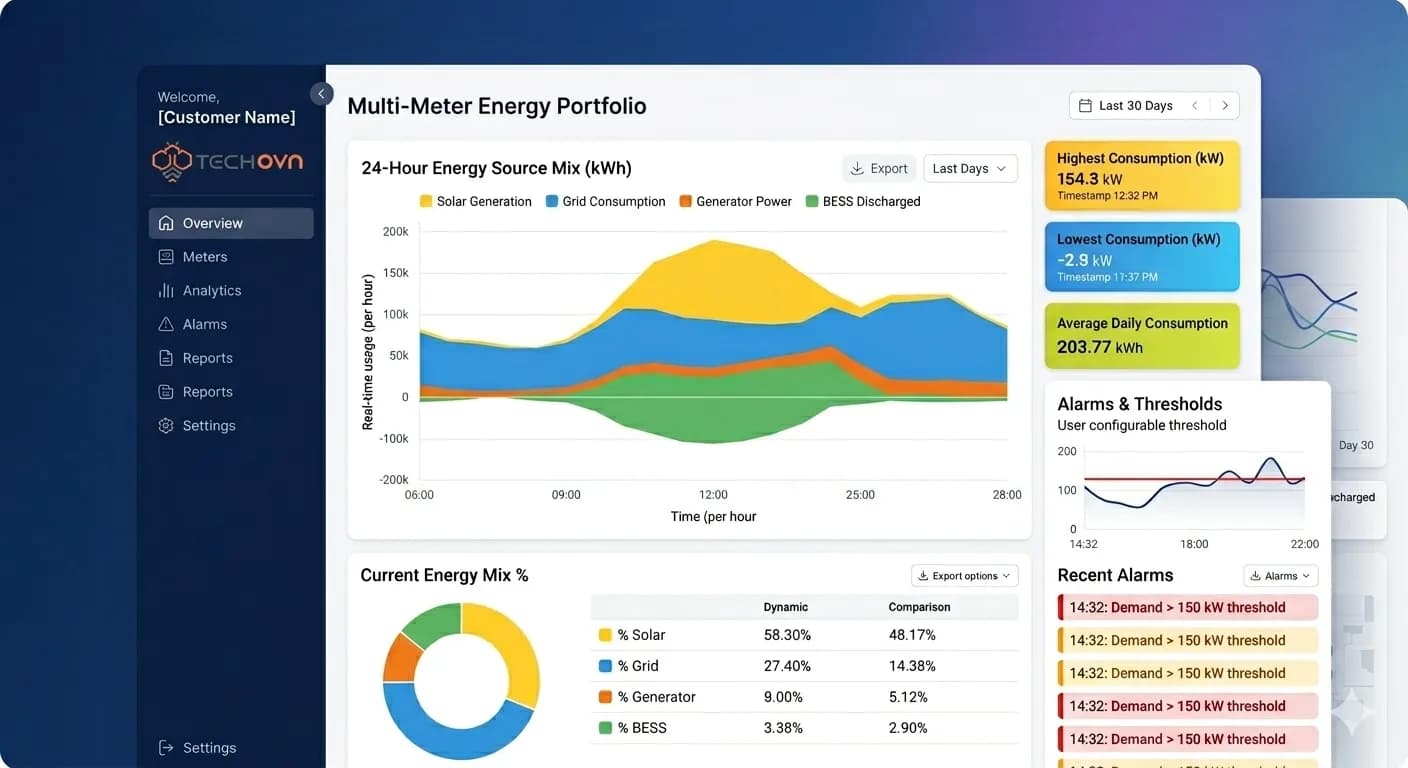
Tech OVN puts a Titan Class 0.5S meter on the supply of each injection moulding machine, CNC, motor or compressor and shows its kWh live, split by shift. Enter the good parts each machine made and the platform gives kWh per part and ₹ per part at your tariff, with no PLC connection. ₹11,000 + GST per machine plus CTs, platform ₹120 per meter per month, shipped from stock.
Built for plants that want machine-wise numbers rather than one bill: plastics and moulding, machining, textiles, foundry, packaging. Monitoring feeders and production lines across a whole plant instead? Use industrial energy monitoring.
At a glance
- What it is
- One Titan Class 0.5S meter per machine, giving live kWh, shift-wise energy and energy cost per part.
- Built for
- Injection moulding, CNC, motors, compressors, extruders, furnaces, presses and packaging lines.
- Cost per machine
- ₹11,000 + GST per meter, CTs extra. Platform ₹120 per meter per month.
- Buying terms
- No catalogue MOQ: a pilot can be two machines. Ships from stock. 2-year warranty.
- Part counts
- Entered on the platform per machine and shift. No PLC or CNC integration needed.
- Integration
- Modbus RTU/TCP and MQTT into your SCADA, MES or ERP if you want the data there too.
Energy Cost per Part Calculator
Enter one machine's energy for a shift and the parts it made. The figures below are a sample shift on a mid-size injection moulding machine; replace them with your own.
One machine, one shift
Energy per part
Specific energy consumption = kWh used ÷ good parts. A Titan meter on the machine supplies the kWh for each shift, so this becomes a measured figure instead of an estimate.
The Bill Doesn't Know Which Machine Made Which Part
A plant gets one electricity bill a month. Two moulding machines making the same part can differ widely in kWh per shot because of age, hydraulic versus servo drives, heater bands, cycle time or a mould that runs cold. On the bill they are the same line item, so the costing sheet uses an average and the expensive machine stays hidden.
Energy is also the cost nobody counts per part. Material is weighed, labour is clocked and cycle time is on the machine display, but electricity is usually spread across every product as overhead. When a customer asks for a price cut, the plant cannot say what a part actually costs to run.
A meter on each machine and a part count per shift turn that overhead into a measured number per part, per machine and per shift.
The Number Each Machine Is Judged By
Specific energy consumption is the same idea everywhere: energy divided by output. Each industry measures output in its own unit.
| Machine | Metric buyers use | What you enter |
|---|---|---|
| Injection moulding machine | kWh per kg of material, kWh per shot | Shots, or kg of material processed |
| CNC, VMC and turning centre | kWh per component | Good components per job or shift |
| Motors: pumps, fans, blowers, conveyors | kWh per hour run, kWh per unit moved | Run hours, or output such as m³ pumped |
| Extruder, spinning and weaving | kWh per kg (UKG in textile mills) | Output in kg |
| Furnace, foundry and forging | kWh per tonne | Tonnes melted, cast or forged |
| Air compressor | kWh per shift; kW per CFM if air flow is measured | Shift hours, or air delivered |
| Presses, welding and packaging lines | kWh per part or per pack | Parts or packs per shift |
How It Works
Three steps, in the order they happen on site.
- 1
Fit a meter on each machine
Your electrician mounts Titan on DIN rail in the machine panel and fits CTs on the three phases, sized to the machine's current. The CT ratio is set in the meter.
- 2
See kWh live
Each meter reports over WiFi or Ethernet to the platform: kW, kWh, power factor and demand per machine, split by shift.
- 3
Enter part counts
Enter the good parts each machine made per shift. The platform calculates kWh per part and energy cost per part at your tariff.
What You See for Every Machine
The platform view, and what the meter hands to your own systems.
kWh per machine, live
kW, kWh, power factor and demand for each machine, updated continuously. The machine that draws power while it makes nothing becomes visible the same day.
Energy cost per part
Enter the good parts each machine made in a shift and the platform divides that shift's kWh by them, then prices it at your tariff. That figure can go straight into a quote.
Shift-wise energy
Consumption split by shift for every machine, so A, B and C shifts can be compared on the same job. For energy per person, divide a shift's kWh by the headcount on it.
Machines against the incomer
One meter on the main incomer and one per machine shows what share of the bill production actually uses, and what goes to lighting, HVAC, compressors and losses.
Demand and power factor per machine
Find which machines set your maximum demand and which drag power factor down, before either shows up as a penalty on the electricity bill.
Your own SCADA, MES or ERP
Every meter also serves Modbus RTU, Modbus TCP and MQTT, so the same kWh can feed a SCADA, MES or ERP you already run. No data path requires a Tech OVN server.
Motors that need condition monitoring as well as energy can use Titan Asset, which adds a vibration sensor to the same meter. Pumps that need dry-run protection belong on the Titan Pump Controller.
Specification and Buying Terms
What a plant engineer or purchase team needs to raise a PO.
| Parameter | Specification |
|---|---|
| What is measured per machine | V, I, kW, PF, frequency, kWh, kVARh, kVAh (import and export), maximum demand |
| Accuracy class | Class 0.5S active energy per IEC 62053-22 |
| Supply | 48 V to 500 V AC, 3-phase 4-wire or 3-wire, 50 Hz or 60 Hz |
| CTs | External CTs with 5 A secondary; CT ratio set in the meter. Supplied 100 A to 1000 A, ring or split-core; lower ratios for small machines |
| Communication | WiFi, Ethernet and RS485 built in. Modbus RTU, Modbus TCP, MQTT, BACnet |
| Platform | Live machine dashboards, shift-wise energy, manual part-count entry, kWh and ₹ per part. ₹120 per meter per month |
| Mounting | DIN rail, 94 × 89 × 69 mm, fits inside a machine panel |
| Certification | CE certified |
| Commercial terms | ₹11,000 + GST per meter, CTs extra. No catalogue MOQ. Regular orders ship from stock; 200+ units 4 weeks from confirmed PO. 2-year warranty |
Frequently Asked Questions
Questions plant owners and engineers ask before metering their machines.
Related Solutions & Products
The plant-wide view, the meters behind this page, and the bill penalties per-machine data helps you avoid.
Industrial Energy Monitoring
Feeder and production-line monitoring across a whole factory or plant group.
Learn More →Titan Smart Energy Meter
The Class 0.5S DIN rail meter on each machine, with WiFi, Ethernet and RS485 built in.
Learn More →Titan Asset
Energy plus vibration on one device, for motors, pumps, compressors and fans.
Learn More →Energy Meters for Factories
Sub-metering, BEE PAT data and condition monitoring for manufacturing plants.
Learn More →Maximum Demand Monitoring
Find the machines that set your maximum demand before the excess-demand penalty lands.
Learn More →Energy Meter Sizing Tool
Work out the meter and CT rating for a machine from its load.
Learn More →Find out what each part costs you in electricity
Tell us how many machines you run and what they make. We will quote meters, CTs and the platform for a pilot or the whole floor.