
Solution
Building Energy Monitoring System
Chiller plant to tenant riser. Into the BMS you already have.
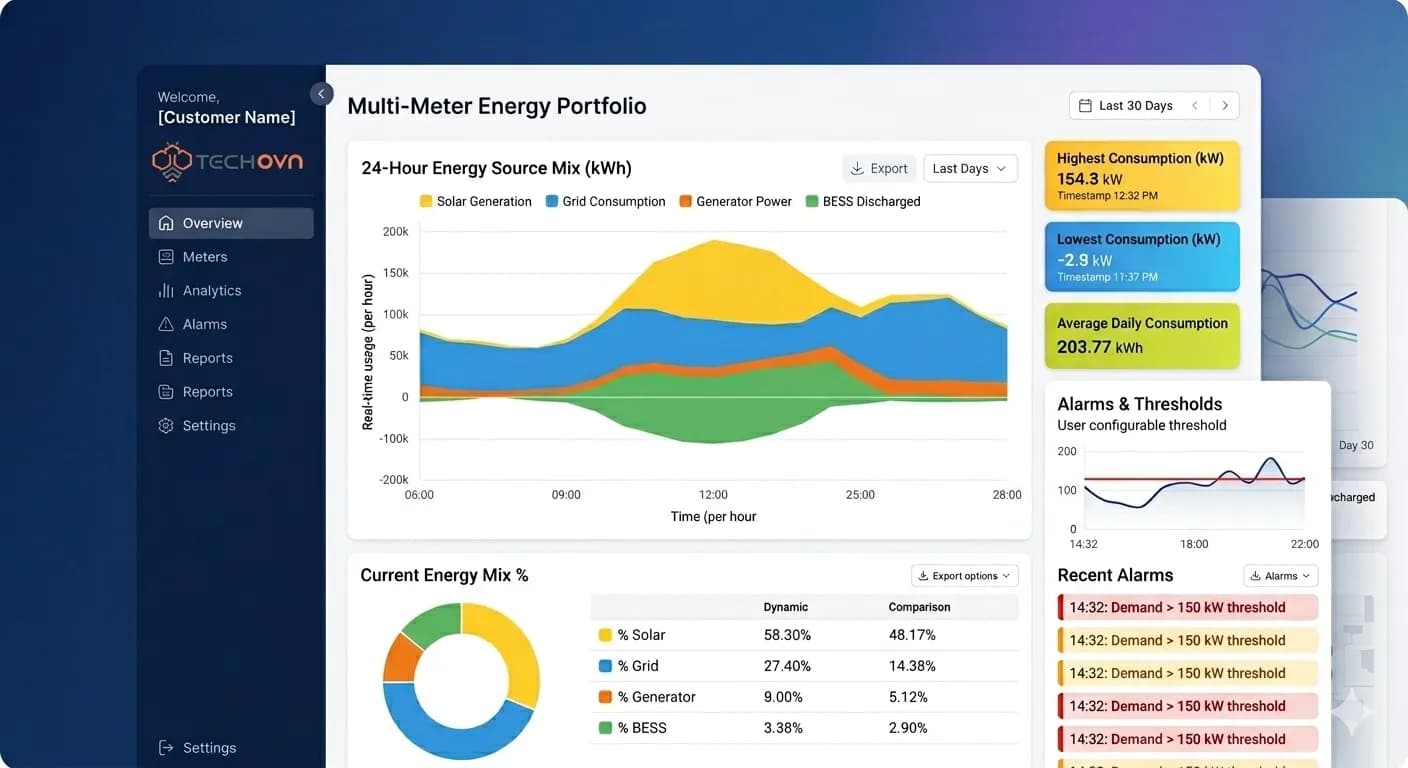
A commercial and business energy monitoring system for offices, malls, hotels, hospitals and campuses. Class 0.5S meters on the circuits that matter — chillers, AHUs, lifts, lighting risers, tenant supplies, car-park charging — feeding your existing BMS natively over BACnet, and a portfolio dashboard if you want one. Monitoring a factory or process plant instead? Use industrial energy monitoring, which is built around motor loads and production lines.
At a glance
- What it is
- Circuit-level Class 0.5S electricity metering across a commercial building, feeding a BMS, a dashboard, or both.
- Built for
- Offices, malls, hotels, hospitals, mixed-use and campuses — single building or a managed portfolio.
- BMS integration
- Native BACnet/IP and BACnet MS/TP, plus Modbus RTU/TCP and MQTT. No gateway, no translation module.
- Cost per point
- ₹8,500–₹18,300 per meter. No catalogue MOQ — a pilot can be one meter. 4 weeks from confirmed PO.
- Per-site infrastructure
- None. No energy-server PC, data concentrator or per-site software licence.
- Reporting
- On-device CO₂ from a configurable grid factor — Scope 2 data for BRSR, CSRD and GHG Protocol.
A Building Bill Is One Number for Fifty Decisions
A commercial building arrives with one utility reading a month. From that single number a property team is expected to apportion CAM charges, answer a tenant who thinks they are overpaying, judge whether the chiller retrofit worked, and fill in an ESG disclosure. None of those questions can be answered from a total.
The gap is widest where the load is largest. HVAC is typically 40–60% of a commercial building's electricity, and chiller efficiency degrades quietly — fouled tubes, refrigerant loss, a failing compressor, pumps running at a fixed speed against a changed load. A chiller consuming 10% more than its commissioned kW/TR does not announce itself. It simply appears in the bill as weather, or occupancy, or nothing in particular.
Metering the circuits individually makes each of those questions answerable with data rather than argument — and because the meters speak BACnet natively, it does so without displacing the building management system you already run.
What to Meter in a Commercial Building
Six circuit groups, in the order they usually repay the meter.
Chiller plant and HVAC
Typically 40–60% of a commercial building's electricity. Metering the chillers, AHUs and pump sets separately is where the first real saving is found, because it is the only way to see kW/TR drifting away from the commissioned figure.
Tenant and common-area supplies
Separating landlord load from tenant load turns CAM charges from an apportioned estimate into measured kWh. It also ends the annual argument, because a disputed bill can be answered with interval data.
Lifts, lighting and small power
The circuits nobody meters individually, which is exactly why nobody can explain the base load. One meter per riser makes overnight and weekend consumption legible.
Standby and critical power
DG sets and UPS feeders metered continuously, so generator cost per kWh and backed-up load are known numbers rather than assumptions discovered during an outage.
Car park and EV charging
EV charging is becoming a material building load and often sits on the landlord's supply. Separate metering is what makes recovery from drivers or tenants defensible.
Kitchens, laundry and amenities
In hotels and malls these are concentrated, schedule-driven loads that respond well to measurement — and they are frequently left running outside operating hours.
It Feeds the BMS You Already Have
In commercial buildings the building management system is usually already installed, already commissioned, and not going anywhere. Honeywell, Siemens Desigo, Johnson Metasys and Schneider EcoStruxure Building all speak BACnet as their native protocol, and most energy meters do not — which is why metering retrofits so often arrive with a BACnet gateway per riser, each one a licence cost, a configuration file and a thing that can fail.
Every Titan meter speaks BACnet/IP over Ethernet or WiFi and BACnet MS/TP over RS485 natively, with no gateway or translation module. Alongside that it runs Modbus RTU, Modbus TCP and MQTT. The RS485 port carries Modbus RTU or BACnet MS/TP, selected at commissioning, because RS485 is a single physical bus and carries one protocol at a time.
So the BMS keeps doing control and gains a metering-grade measurement layer underneath it. If you would rather the data went somewhere else — a tenant-billing system, a portfolio analytics platform, your own cloud — MQTT publishes to any broker you configure, and no data path requires a Tech OVN server. The EMS vs BMS vs SCADA comparison sets out where each system's job starts and stops.
Class 0.5S matters here for a commercial reason, not a technical one: it is the accuracy class utilities use for revenue billing, so a tenant invoice generated from it survives being challenged.
Start With the Chiller Plant
If HVAC is half the building's electricity, the chiller plant is where measurement pays back first. Electrical metering on the chiller supply gives you consumption and demand. Adding thermal measurement on the chilled-water loop gives you the ratio that actually describes efficiency — kW/TR, and from it COP.
That ratio is the one number a plant room cannot fake. It moves when tubes foul, when refrigerant is low, when a compressor stage is failing, and when pumps and towers are sequenced badly. Measured continuously against the commissioned figure, it turns chiller maintenance from a calendar exercise into a condition-led one.
For electrical-only monitoring the Titan meter is enough. For measured kW/TR and COP on a single device, use Titan Plus BTU, which combines Class 0.5S electrical metering with EN 1434 Class 2 thermal metering. If cooling is being billed to tenants rather than just monitored, that belongs on HVAC and chilled-water billing. You can model the numbers first with the chiller COP calculator.
Specification
What a consultant or specifier needs to write this into a tender.
| Parameter | Specification |
|---|---|
| Accuracy class | Class 0.5S active energy per IEC 62053-22 — the class utilities use for revenue billing, so tenant bills hold up when disputed |
| Voltage / current | 48 V to 500 V AC, 3-phase 4-wire or 3-wire; CT primary 10 A – 1000 A |
| Parameters measured | V, I, P, PF, f, kWh, kVARh, kVAh (import and export), maximum demand (kW, kVA, A) |
| Tariff registers | Time-of-use / ToD registers configurable on-device; kVAh registers for apparent-energy tariffs |
| Power quality | Individual voltage and current harmonics to the 31st order per phase, plus THD-V and THD-I — enough to catch distortion from VFDs, LED drivers, UPS and lift drives |
| BMS protocols | BACnet/IP over Ethernet or WiFi, BACnet MS/TP over RS485 — native, no gateway |
| Other protocols | Modbus RTU (RS485), Modbus TCP (port 502), MQTT to any broker (TLS), HTTP/HTTPS and TCP/IP push |
| Protocol selection | RS485 carries Modbus RTU or BACnet MS/TP, selected at commissioning — one at a time, because RS485 is a single physical bus |
| Per-site infrastructure | None. WiFi and Ethernet built in — no energy-server PC, no data concentrator, no per-site licence |
| Sustainability | On-device CO₂ using a configurable grid emission factor — Scope 2 data for BRSR, CSRD and GHG Protocol |
| Mounting | DIN rail, 94 × 89 × 69 mm — fits an existing riser sub-board or landlord panel without rework |
| Environment | −25 °C to +70 °C, UL94 V-0 self-extinguishing enclosure, IP51 front face, EMC per IEC 61000-4 series |
| Commissioning | Titan smartphone app over WiFi — no laptop, serial cable or proprietary software |
| Commercial terms | ₹8,500–₹18,300 per meter. No catalogue MOQ, single units from stock. 4 weeks from confirmed PO. Made in India |
Frequently Asked Questions
Eight questions property and facility teams ask before specifying a building energy monitoring system.
Related Solutions & Products
The industrial counterpart, the people who run this, and the meters behind it.
Industrial Energy Monitoring
The factory and process-plant counterpart to this page — motor loads, production lines, compressed air and DG sets.
Learn More →Facility Management
One measurement layer serving the energy budget and the maintenance budget together, across a building or a portfolio.
Learn More →Energy Management System (EMS)
The platform above the meters — portfolio dashboards, ISO 50001 EnPI tracking and automated reporting.
Learn More →Titan Smart Energy Meter
Class 0.5S 3-phase DIN rail meter with WiFi, Ethernet and RS485, and native BACnet. The meter behind the monitoring.
Learn More →HVAC / Chilled-Water Billing
Billing tenants for cooling on measured thermal energy rather than apportioned floor area.
Learn More →Electricity Sub-Metering
Tenant and departmental sub-metering, CAM reconciliation and defensible chargeback.
Learn More →See where your building's energy actually goes
Talk to our team about metering a building or a portfolio — including which circuits to meter first and how it lands in your BMS.