
Energy Management System for Data Centres & Colocation Facilities
An Energy Management System (EMS) built for data centres on the Tech OVN Energy Intelligence Platform — continuous PUE measurement, rack-level submetering for colocation billing, and 2N redundancy validation. ISO 27001-aligned cloud, deployed across Indian and Southeast Asian colocation operators.
PUE Is the KPI. Your Meters Decide if You Can Trust It.
Power Usage Effectiveness is the single number that defines data centre efficiency. But a PUE reported once a month from estimated IT loads isn't a KPI — it's a story. A real Energy Management System measures the incomer, the UPS output, every mechanical feeder, and every rack — continuously. That's what makes PUE actionable, billable, and defensible in front of a sustainability auditor.
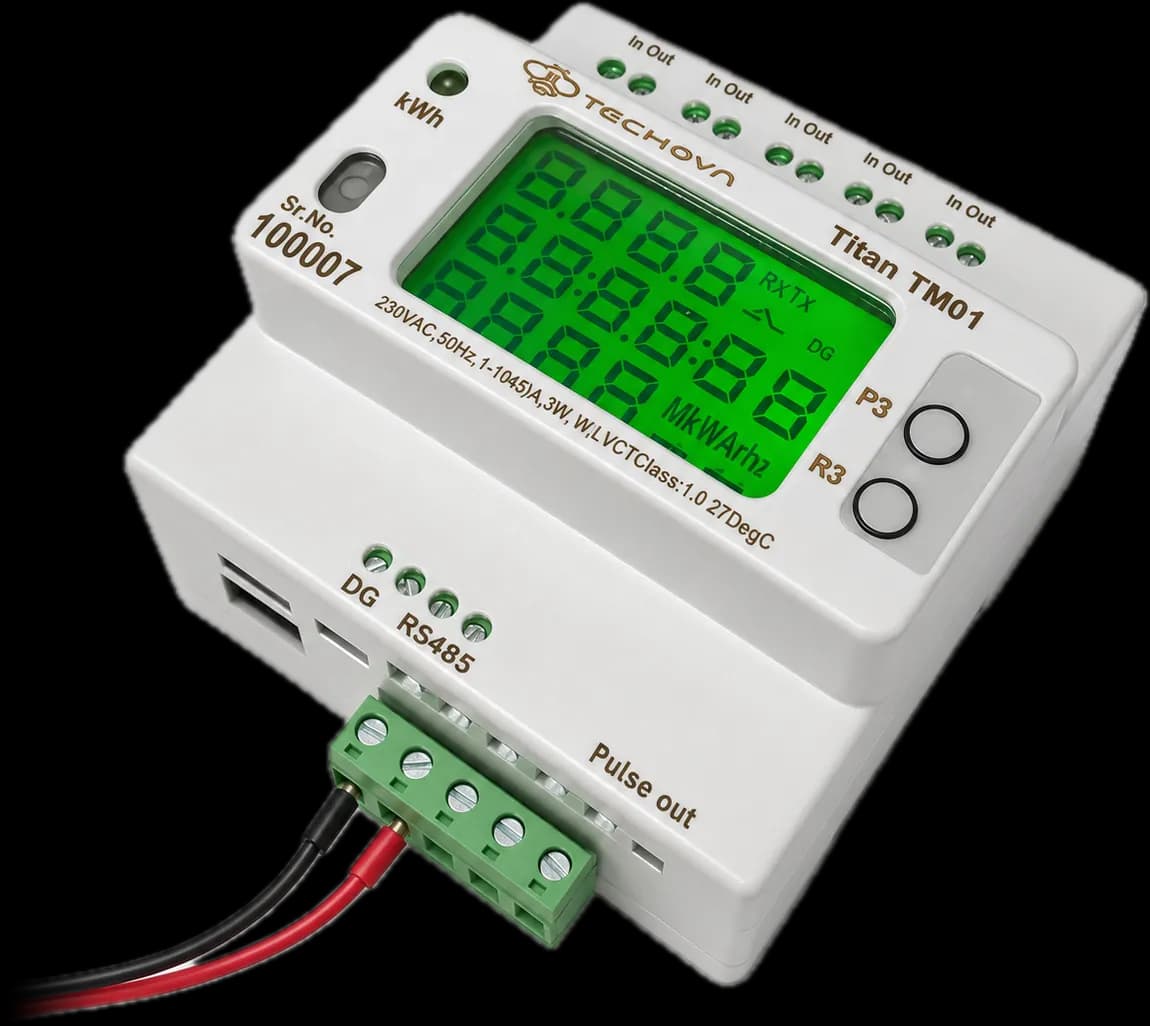
The Tech OVN EMS combines Titan meters with the Tech OVN Energy Intelligence Platform — a multi-tenant cloud SaaS built for colocation operators, hyperscale tenants, and enterprise data centre teams. Real-time PUE, per-rack billing, and redundancy validation — meters report to the platform natively over secure MQTT, no gateway required.
What a Data Centre EMS Does
Six capabilities that move PUE from a monthly story to a real-time KPI.
Real-Time PUE Measurement
Continuous Power Usage Effectiveness calculation — total facility power vs IT load — refreshed every few seconds, not as a monthly average. Spot HVAC drift, free-cooling failures, or UPS inefficiency the moment they happen.
Rack-Level Submetering for Colocation Billing
Titan submetering at the rack, the PDU, or the customer cage. Auto-generated invoices per customer, per rack, per kWh actually used, with audit-ready supporting data on the Tech OVN Energy Intelligence Platform.
Redundancy & Source Validation
Track grid, DG, UPS-A and UPS-B feeds independently. Validate that 2N redundancy is actually 2N, detect transfer-switch anomalies, and catch a degraded UPS battery string before the next outage exposes it.
IT vs Cooling vs Lighting Split
Sub-meter chillers, CRACs, lighting, and IT loads separately. The split tells you exactly where your PUE gap is — and which mechanical or electrical project will move it the most.
Multi-Tenant Dashboard for Colo Customers
Role-based access on the Tech OVN Energy Intelligence Platform — each colocation customer sees only their racks and their bills. Operations team sees the full facility. No customer-portal build, no separate billing tool.
ESG & Sustainability Reporting
Scope 2 carbon emissions auto-calculated per customer, per rack, per region. Renewable mix percentages for green-tariff customers. Ready for CDP, GRESB, and SBTi disclosures.
Where the Meters Go
PUE is total facility energy divided by IT equipment energy. Both numbers need a meter, and where you place them decides how far down the measurement chain you can credibly report.
| Measurement point | What it gives you |
|---|---|
| Utility incomer | Total facility energy — the numerator. Non-negotiable for any PUE figure. |
| Transformer / LT panel | Distribution losses, and a cross-check against the incomer reading. |
| UPS input and output | UPS conversion losses, and the coarsest usable IT-load figure. |
| PDU output | A tighter IT-load number that excludes PDU losses from the IT side. |
| Branch circuit | Per-circuit visibility — where capacity planning and stranded-power recovery start. |
| Rack / customer cage | Per-rack consumption for colocation billing and per-tenant reporting. |
| Mechanical feeders | Chillers, CRACs and pumps metered separately — this is what tells you which project moves PUE. |
How far down you measure decides what you can claim
The Green Grid defines PUE at increasing levels of rigour, separated by where IT load is measured — at the UPS output, at the PDU output, or at the IT equipment input itself. Each step down the chain removes a set of distribution losses from the IT side of the ratio and makes the reported figure harder to argue with.
Most Indian facilities measure total power at the incomer and infer IT load from UPS ratings. That produces a number, but not one that survives a customer audit. Metering the UPS output directly is usually the cheapest step up in credibility; going to PDU or branch circuit is what colocation billing needs anyway.
Why accuracy class matters more here than elsewhere
PUE is a ratio of two large numbers that produces a small one — typically between 1.3 and 1.8. A measurement error of a percent or two on either side moves the reported figure materially, and in the wrong direction it turns an efficiency win into a rounding artefact. Titan measures to Class 0.5S under IEC 62053-22, which keeps the ratio defensible rather than indicative.
Retrofitting a live facility
Adding metering to a running data centre is usually a change-control problem rather than an engineering one. Split-core CTs are available where clamping around existing cable is needed, so feeders can be instrumented without breaking conductors or scheduling a shutdown — which is generally the difference between a project that gets approved and one that stalls.
Frequently Asked Questions
PUE measurement, colocation billing, redundancy validation, and deployment — common questions from data centre operations and sustainability teams.
Real-time PUE, billable rack-level metering, ISO-aligned
Talk to our team about a pilot at one site or one row. Titan meters, Tech OVN Energy Intelligence Platform (multi-tenant SaaS), MQTT-native commissioning.